By Talha Latief Tantray
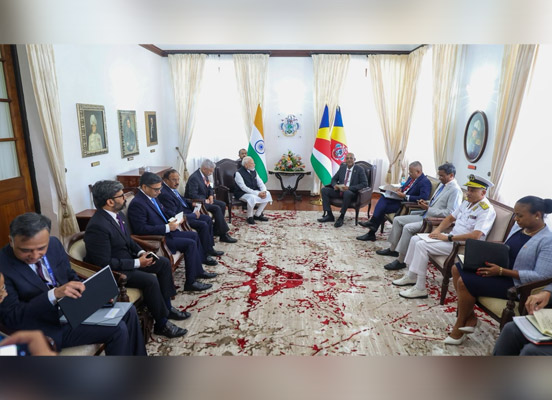
Prime Minister Narendra Modi’s visit to Seychelles on 27–29 June marks more than a diplomatic milestone; it signals India’s growing determination to shape the future security and governance of the Indian Ocean.
Timed to coincide with the Golden Jubilee of Seychelles’ independence and fifty years of diplomatic relations between the two countries, the visit reflects New Delhi’s broader ambition to strengthen partnerships with strategically located island nations at a time of intensifying geopolitical competition in the Indo-Pacific.
The most visible outcome of the visit was the handover of PS Lespwar, a Made-in-India Fast Patrol Vessel (FPV) built by Goa Shipyard Limited, to the Seychelles Coast Guard. Alongside six ambulances, utility vehicles, laser boats and development assistance, the vessel demonstrates India’s long-standing commitment to enhancing the maritime capabilities of its island partner.
For Seychelles, which manages an Exclusive Economic Zone of nearly 1.37 million square kilometers, strengthening maritime surveillance is essential to combat piracy, illegal fishing, narcotics trafficking and other transnational threats.
However, the visit’s significance extends far beyond defense cooperation. It showcased the operationalization of India’s MAHASAGAR (Mutual and Holistic Advancement for Security and Growth Across Regions) vision, unveiled in 2025 as an evolution of the earlier SAGAR doctrine.
While SAGAR focused primarily on India’s immediate maritime neighborhood, MAHASAGAR adopts a broader outlook by promoting maritime security, sustainable development, blue economy cooperation and resilient regional institutions across the wider Indian Ocean.
The signing of nineteen agreements across sectors, including health, agriculture, shipping, space cooperation and extradition, illustrates the expanding scope of bilateral relations.
India’s announcement of a ₹1,250 crore Line of Credit and the agreement to introduce the Unified Payments Interface (UPI) in Seychelles further underline New Delhi’s strategy of combining strategic partnerships with economic and technological connectivity. These initiatives strengthen India’s soft power while creating practical benefits for trade, tourism and financial integration.
Climate cooperation also emerged as a central pillar of the visit. Seychelles’ decision to join the Coalition for Disaster Resilient Infrastructure reflects growing convergence with India’s climate diplomacy.
As one of the world’s most climate-vulnerable island states, Seychelles views resilient infrastructure and sustainable development as matters of national survival rather than policy preference. Prime Minister Modi’s emphasis on climate justice and equitable global responsibility resonated strongly with this shared concern.
A particularly symbolic moment came when Prime Minister Modi became the first Indian Prime Minister to address the National Assembly of Seychelles. His address highlighted the shared democratic values, historical ties and maritime heritage that have underpinned bilateral relations for five decades.
Equally significant was the conferment of the prestigious Guardian of the Blue Horizon award, recognizing India’s contributions to maritime security, environmental protection and sustainable development.
The strategic context of the visit cannot be ignored. The Western Indian Ocean has become an increasingly contested geopolitical space amid China’s expanding maritime presence through ports, infrastructure projects and strategic investments stretching from East Africa to South Asia.
For India, partnerships with countries such as Seychelles, Mauritius and the Maldives are becoming indispensable components of a broader regional strategy aimed at preserving a free, open and inclusive Indian Ocean.
Unlike traditional power projection, India’s approach has emphasized capacity building, development assistance and institutional partnerships. This model has enabled New Delhi to position itself as a trusted security partner without creating dependencies or imposing political conditions.
As the Indian Ocean assumes greater significance in global geopolitics, India’s partnership with Seychelles offers a compelling example of how strategic cooperation can be built on mutual trust, shared interests and sustainable development.
More importantly, it demonstrates that the future of the Indo-Pacific will be shaped not only by major powers but also by meaningful partnerships with small island states that occupy critical positions in the region’s evolving maritime order.
(Dr Talha Latief Tantray is an Assistant Professor, School of International Relations and Peace Studies, Nalanda University, India. His research interests include maritime security, Indo-Pacific geopolitics, India's foreign policy, and international security.)
The views expressed are not necessarily those of The South Asian Times