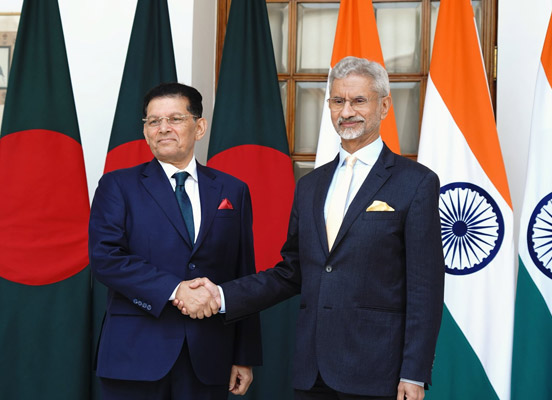
A slow rebuilding of trust between New Delhi and Dhaka signals opportunity, but unresolved security anxieties, political shifts, and regional rivalries continue to cast long shadows.
By K S TOMAR
The evolving engagement between India and Bangladesh marks a careful, almost understated recalibration rather than a dramatic diplomatic breakthrough. After a period of visible strain, both sides appear to have embraced a strategy of quiet diplomacy—eschewing rhetorical grandstanding in favour of incremental trust-building.
The recent visit of Tarique Rahman’s close aides, described deliberately as a “goodwill” mission rather than an official negotiation, reflects a shared understanding: that repairing a relationship burdened by suspicion requires patience, not posturing.
This slow but deliberate approach underlines a broader reality—both nations recognize the strategic indispensability of each other, even as they navigate competing domestic and geopolitical pressures.
The role of the United States in this evolving dynamic, though understated, has been quietly constructive.
Washington’s consistent emphasis on a stable, secure, and economically integrated Indo-Pacific has encouraged both India and Bangladesh to avoid escalatory postures and prioritize functional cooperation.
Through its diplomatic engagement with Dhaka on governance, economic reforms, and security cooperation, and its deepening strategic partnership with New Delhi, the United States has created a broader environment conducive to regional stability.
Its support for connectivity initiatives, maritime security, and supply-chain resilience in the Bay of Bengal indirectly reinforces the logic of closer India–Bangladesh coordination.
While Washington is not a direct mediator, its strategic signaling in favor of a balanced and cooperative regional order has contributed to nudging both sides towards pragmatic engagement rather than confrontation.
Interdependence beyond 1971
At the core of this reset lies a mutual acknowledgement that India and Bangladesh are not merely neighbors but interdependent actors in a rapidly shifting Asian landscape.
For New Delhi, Dhaka remains central to its eastern neighborhood policy, connectivity ambitions, and security calculus in the Northeast. For Bangladesh, India is not just the largest neighbor but also a critical economic partner and geographic gateway.
Yet, the relationship today is no longer anchored solely in the historical goodwill of 1971; it must adapt to a new generation, new political leadership, and new geopolitical realities. The emphasis articulated by Dhaka on “equity, fairness and mutual dignity” signals a departure from a past where asymmetry often shaped perceptions.
India’s security and political challenges
However, this cautious ascent is accompanied by significant challenges before India. Foremost among them is the question of security. The re-emergence of Islamist groups and the potential revival of networks such as Harkat-ul-Jihad al-Islami Bangladesh and Jamaat-ul-Mujahideen Bangladesh remain persistent concerns.
India’s Northeast, historically vulnerable to cross-border insurgency and arms smuggling, cannot afford a relapse into instability. Compounding this is Dhaka’s calibrated outreach to Pakistan’s establishment, which raises apprehensions in New Delhi about intelligence linkages and strategic signalling. India’s dilemma is clear: it must engage the evolving Bangladeshi political spectrum without appearing to compromise on its core security red lines.
Equally pressing for India is the management of domestic political rhetoric that often spills over into foreign policy. The recurring narrative around illegal migration and the portrayal of minorities in Bangladesh as victims of systemic persecution has generated resentment in Dhaka.
Such narratives, amplified during electoral cycles in border states, risk undermining diplomatic efforts by feeding mistrust. If India seeks a stable and cooperative Bangladesh, it must align its domestic discourse with its strategic objectives—something easier said than done in a politically polarised environment.
Bangladesh’s balancing act and internal pressures
Bangladesh, on its part, faces an equally complex set of challenges in resetting ties. The legacy of the previous regime led by Sheikh Hasina, which had cultivated a strong alignment with India, has given way to a more assertive foreign policy under the banner of “Bangladesh First.”
While this doctrine emphasizes sovereignty and strategic autonomy, its practical execution requires a delicate balancing act. Dhaka’s cautious engagement with Pakistan, alongside the political space occupied by groups such as Jamaat-e-Islami Bangladesh, has introduced new variables that complicate its engagement with India.
The leadership must reassure New Delhi that this outreach does not translate into any dilution of its commitments on counter-terrorism and regional stability.
Another major challenge for Bangladesh lies in managing politically sensitive issues such as the continued presence of Sheikh Hasina in India. While Dhaka has chosen not to make bilateral ties hostage to a single issue, the question of her political future and legal accountability remains a domestic political concern.
Balancing this with the need to maintain a functional relationship with India will test the maturity of Bangladesh’s leadership. Moreover, the emphasis on people-to-people ties must translate into tangible outcomes—ease of travel, educational exchanges, and economic cooperation—if the reset is to gain public legitimacy.
Regional fallout: China, Pakistan and the Asian balance
The broader regional implications of this cautious rapprochement are equally significant. For China, which has steadily expanded its footprint in Bangladesh through infrastructure investments and strategic partnerships, a renewed India–Bangladesh understanding could act as a counterbalance.
While Dhaka has maintained that it will avoid exclusive security alignments, its economic engagement with Beijing remains substantial. A stable relationship with India provides Bangladesh with greater strategic flexibility, allowing it to avoid overdependence on any single external actor.
At the same time, the recalibration affects the wider Asian balance. A cooperative India–Bangladesh axis strengthens regional connectivity initiatives, from trade corridors to energy networks, potentially reshaping economic flows across South and Southeast Asia.
It also reinforces the idea of a more integrated eastern subcontinent, which could serve as a bridge between South Asia and ASEAN economies. Conversely, any breakdown in this relationship would create openings for external powers to exploit divisions, thereby complicating the regional security architecture.
Mutual gains: Strategic and economic dividends
Despite the challenges, the advantages of a stable and forward-looking partnership are substantial for both countries. For India, a friendly and cooperative Bangladesh ensures a secure eastern frontier, facilitates connectivity to the Northeast, and enhances its regional influence.
It also provides a platform for addressing shared challenges such as climate change, river water management, and migration in a collaborative framework. For Bangladesh, improved ties with India translate into economic opportunities, energy security, and access to a vast market. The continued supply of fuel and power cooperation between the two countries underscores the practical benefits of this relationship.
More importantly, both nations stand to gain from a shift in narrative—from one defined by suspicion and episodic tensions to one anchored in mutual respect and pragmatic cooperation. The median age of Bangladesh, at around 27, highlights the urgency of this transition. A younger generation, less bound by historical memories and more focused on economic aspirations, demands a relationship that delivers tangible benefits rather than symbolic gestures.
A cautious but necessary ascent
Ultimately, the India–Bangladesh relationship is at a crossroads where caution is not a weakness but a strategic necessity. The slow rebuilding of trust, the avoidance of public grandstanding, and the focus on incremental progress reflect a mature recognition of the complexities involved. Yet, this process will require sustained political will, careful management of domestic narratives, and a clear-eyed understanding of regional dynamics.
The path ahead is neither linear nor assured. But if both sides can navigate their respective challenges with foresight and restraint, this cautious ascent could well evolve into a durable partnership—one that not only stabilises bilateral ties but also contributes to a more balanced and cooperative Asian order.
--------------------------------------------

(K S Tomar is a strategic affairs columnist and senior political analyst based in Shimla)
The views expressed are not necessarily those of The South Asian Times