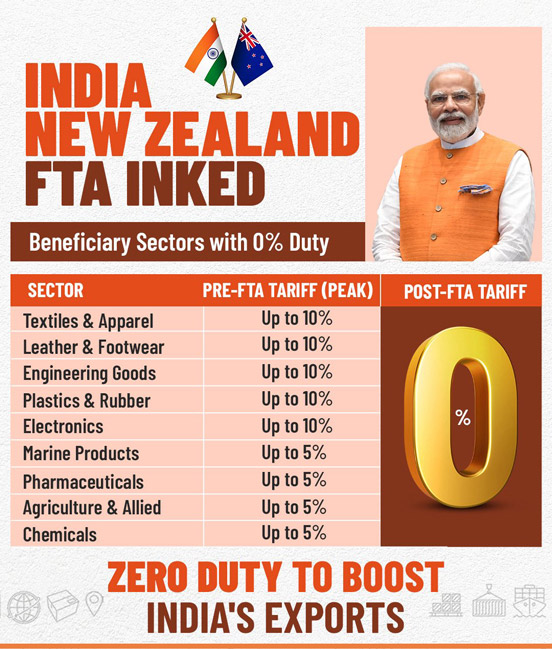
Billed as India's first women-led Free Trade Agreement, the pact removes tariffs on 100 percent of India’s exports to New Zealand, along with Wellington’s $20 billion investment commitment to accelerate India’s development trajectory.
New Delhi: Calling it a transformative step for inclusive growth, Prime Minister Narendra Modi said the newly signed India-New Zealand Free Trade Agreement (FTA) will unlock wide-ranging opportunities across key segments of society, from farmers and small businesses to startups and students.
PM Modi described the pact as a ‘landmark moment’ in bilateral ties, emphasising that it reflects the deep trust, shared values and growing ambition between the two nations. He underlined that the agreement is not just about trade expansion but about empowering diverse sections of society and accelerating India’s development trajectory.
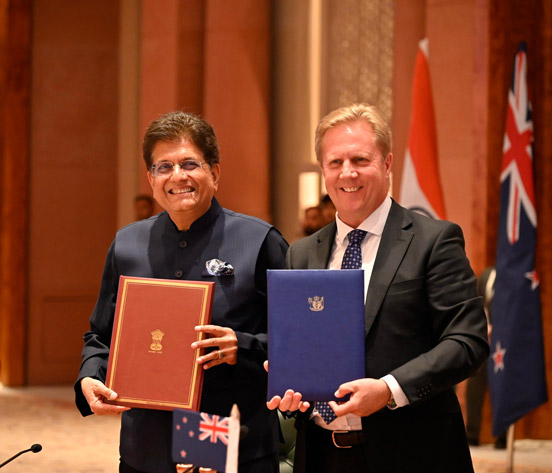
Commerce and Industry Minister Piyush Goyal with his New Zealand counterpart Todd McClay in New Delhi.
“Today marks a landmark moment in the India-New Zealand partnership. I am delighted that the India-New Zealand FTA signed today will add unprecedented momentum to our developmental partnership,” PM Modi said. “It reflects the deep trust, shared values and ambition that bind our two nations,” the Prime Minister stated.
He also highlighted New Zealand’s $20 billion investment commitment, noting that it would strengthen cooperation in agriculture, manufacturing, innovation and technology, paving the way for a more dynamic economic partnership.
Echoing similar optimism, New Zealand Prime Minister Christopher Luxon described the deal as a “historic milestone” that signals a new phase in bilateral relations. Luxon recalled that negotiations began just 13 months ago following his visit to India, and credited ministers and officials from both countries for swiftly concluding a comprehensive agreement.
5,000 visas for skilled Indians
New Delhi: The India-New Zealand FTA is India's first women-led Free Trade Agreement and a defining milestone in the bilateral economic journey of the two countries, Commerce and Industry Minister Piyush Goyal said in the presence of New Zealand Trade and Investment Minister, Todd McClay.
The FTA includes several provisions relating to the mobility of working professionals and students. New Zealand has signed an annex on student mobility and post-study work visas for the first time with any country. Under this, Indian students can work up to 20 hours per week while studying in New Zealand, with extended post-study work visas.
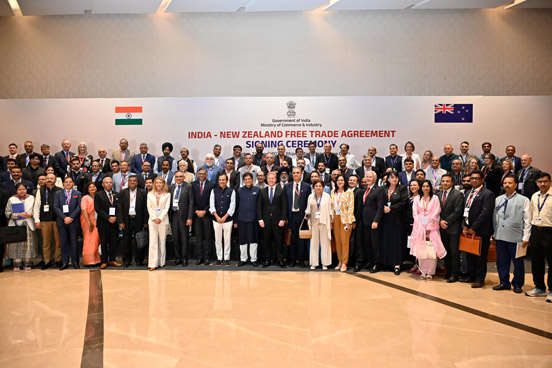
Delegates at the India-New Zealand Business Forum in New Delhi.
Further, the agreement includes a quota of 5,000 visas for skilled Indians for a stay of up to three years in the sectors of interest to India, which include AYUSH practitioners, yoga instructors, chefs, and music teachers, as well as other key sectors such as IT, engineering, healthcare, education, and construction.
Under the Working Holiday Visa programme included in the agreement, 1,000 young Indians annually can avail multiple entries in New Zealand for a period of 12 months. India has also managed to keep several items out of the FTA, including all dairy products such as milk, cream, whey, yoghurt and cheese as well as agricultural produce such as onions.
New Zealand’s $20 billion commitment
The FTA also includes a provision wherein New Zealand will invest $20 billion in India over 15 years. This is in the same vein as the $100 billion investment ‘commitment’ the European Free Trade Association made in their FTA with India.
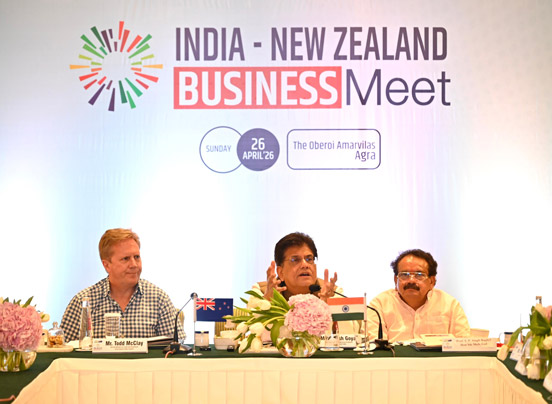
Piyush Goyal and Todd McClay had an enriching industry engagement in Agra.
The FTA with New Zealand is expected to give a big push to India’s leather industry, which expects to grow to $50 billion by 2030, driven by a strategic shift from mass production to high-value-added manufacturing, according to a statement issued by the Ministry of Commerce and Industry.
With the FTA eliminating duties on 100 per cent of Indian exports, and bringing tariffs on leather and footwear from 5 per cent to zero, Indian exporters are set to gain a decisive competitive advantage.
(All photos courtesy: X@PiyushGoyal)