
India is among the world’s fastest-growing major economies and is well-positioned to sustain this momentum. With the ambition of attaining high middle-income status by 2047 - the centenary year of its independence- the country is building on strong foundations of economic growth, structural reforms, and social progress
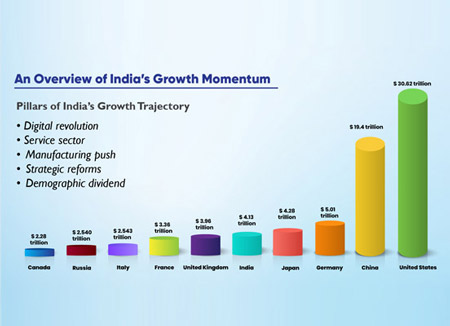
New Delhi: With GDP valued at $4.18 trillion, India has likely surpassed Japan to become the world’s fourth-largest economy and is poised to displace Germany from the third rank in the next 2.5 to 3 years with a projected GDP of $7.3 trillion by 2030.
The growth momentum further surprised on the upside, with GDP expanding to a six-quarter high in Q2 of 2025-26, reflecting India’s resilience amid persistent global trade uncertainties. Domestic drivers-led by robust private consumption-played a central role in supporting this expansion, according to the government.
(Photo courtesy: X@medcindia)
India’s real GDP grew 8.2 percent in Q2 FY2025-26, up from 7.8 per cent in the previous quarter and 7.4 per cent in Q4 of 2024-25, led by resilient domestic demand amidst global trade and policy uncertainties. Real gross value added (GVA) expanded by 8.1 per cent, catalysed by buoyant industrial and services sectors.
High-frequency indicators point to sustained economic activity: inflation remains below the lower tolerance threshold, unemployment is on a declining trajectory, and export performance continues to improve. Furthermore, financial conditions have stayed benign, with strong credit flows to the commercial sector, while demand conditions remain firm, supported by a further strengthening of urban consumption.
Moreover, the RBI has revised India’s GDP growth forecast for FY 2025-26 upwards to 7.3 per cent from the earlier estimate of 6.8 per cent. India’s domestic growth is on an upward trajectory owing to multiple factors such as- robust domestic demand, income tax and goods and services tax (GST) rationalisation, softer crude oil prices, front-loading of Government capital expenditure (CAPEX), along with facilitative monetary and financial conditions, supported by benign inflation.
(Photo courtesy: X@infoindata)
External factors such as services exports are projected to remain robust, while the swift conclusion of current trade and investment negotiations offers additional upside potential. Ongoing reforms are likely to further enable growth prospects. Present macro-economic situation presents a rare “goldilocks period” of high growth and low inflation, said the statement.
CPI inflation for FY 2025-26 is projected at 2 per cent, comfortably within the RBI’s target range of 2–6 per cent. The quarterly inflation path for FY26 indicates 0.6 per cent in Q3 followed by 2.9 percent in Q4. For FY27, it is projected at 3.9 per cent in Q1 and 4.0 percent in Q2.
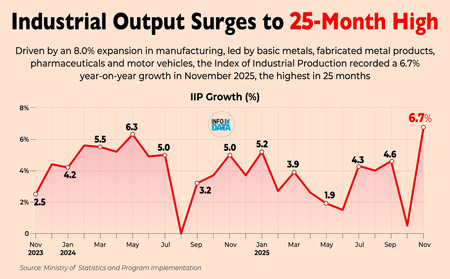
India’s industrial output strengthened sharply with the Index of Industrial Production (IIP) rising 6.7 per cent in November 2025, marking the highest growth in 25 months, supported by broad-based manufacturing gains led by basic metals, pharmaceuticals and motor vehicles.
(Photo courtesy: X@infoindata)
As one of the world’s youngest nations, India’s growth story is being shaped by its ability to generate quality employment that productively absorbs its expanding workforce and delivers inclusive, sustainable growth.
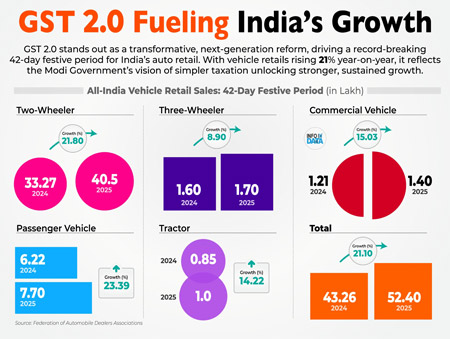
Robust GST reforms herald positive impact on economyNew Delhi: Over the past years, the government has undertaken a historic wave of reforms, abolishing over 40,000 unnecessary compliances and repealing more than 1,500 outdated laws, thus creating a modern, efficient, and citizen-friendly ecosystem. The GST rate rationalisation, which came into effect from September 22 this year, was one such ‘Big Bang reform’ towards building a 'Viksit Bharat'. According to the Finance Ministry, the rollout of GST 2.0 has started showing a positive impact on India’s economy, with stronger consumption trends, higher sales across key sectors like automobiles, and improved consumer sentiment. India’s vehicle sales recorded impressive year-on-year growth across all segments during the 42-day festive season. The revision in GST rates resulted in a 5 per cent growth in the revenue of states (Gross SGST+IGST settled to States). Minister of State for Finance Pankaj Chaudhary said that the GST collections during September to November of the current financial year (2025-26) have risen to Rs 2,59,202 crore from Rs 2,46,197 crore in the same period of 2024-25. India’s GST collection recorded a 6.1 per cent increase to Rs 1,74,550 crore in December 2025 compared to Rs 1,64,556 crore the same month of the previous year, reflecting the increase in economic activity during the month. According to Finance Minister Nirmala Sitharaman, after income tax and GST reforms, the next focus of the government is the simplification of the customs tax system. |