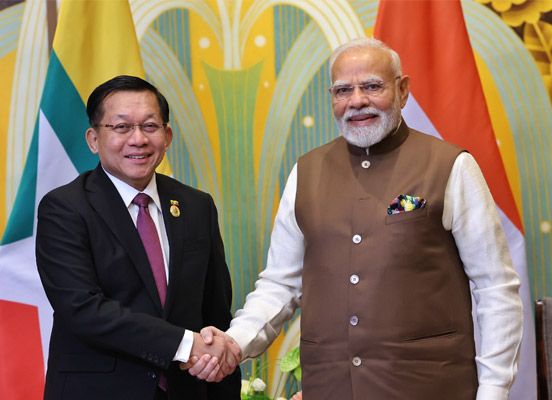
Min Aung Hlaing’s scripted electoral plan is more a calculated attempt to cloak military rule, deepening instability and reshaping strategic equations for India, China, and the wider region.
By K S TOMAR
An election announced to seal, not surrender, military power
When Senior General Min Aung Hlaing declared that Myanmar would hold staggered elections from December 28, 2025, the announcement was framed as a national milestone. In reality, it symbolized a deeper descent into authoritarian farce. Four years after the 2021 coup that dismantled Aung San Suu Kyi’s elected government, the junta is attempting to rebrand itself through a poll that carries the unmistakable signature of manipulation. With opposition parties banned, leaders jailed, and large sections of the country controlled by resistance forces, the military’s promise of a “democratic restoration” is little more than a political charade designed to legitimize its crumbling rule. Instead of hope, the announcement has evoked anger and disillusionment across a nation still bleeding from conflict.
Washington weighs China, under Trump’s second term
Under Donald Trump’s new term, Washington’s policy will be filtered through the lens of US-China competition rather than other considerations. Biden-era sanctions and support to the NUG may not continue with the same intensity. The critical calculation for Trump will be simple: can Myanmar be used as a pressure point to restrict China’s access to the Indian Ocean? Supporting resistance groups could achieve this, but risks escalation. Ignoring Myanmar, meanwhile, could give China unchallenged influence. Trump’s transactional worldview suggests that strategic relevance will determine America’s stance.
China’s dual game and its expanding strategic grip
No external power has gained more from Myanmar’s turmoil than China. Beijing supports Min Aung Hlaing diplomatically and militarily while simultaneously nurturing relationships with powerful northern ethnic armies. This dual-track approach ensures that China remains indispensable to all sides. The Kyaukphyu deep-sea port and China-Myanmar Economic Corridor are central pillars of China’s Belt and Road strategy, offering Beijing direct access to the Bay of Bengal.
With the junta dependent on Chinese arms, credit, and diplomatic cover, Beijing holds decisive influence. Ironically, as resistance fighters capture towns—from Ann to Thandwe and Lashio—China’s leverage grows even further, because both the military and the rebels seek its approval. For Beijing, Myanmar is not a battleground of democracy but a strategic bridge to the Indian Ocean.
ASEAN’s silence and the collapse of regional diplomacy
ASEAN, once expected to stabilize Myanmar, has been unable to move beyond rhetorical resolutions. Its Five-Point Consensus has become symbolic rather than actionable. At the 58th ASEAN Foreign Ministers’ Meeting in July 2025, member states repeated familiar statements without offering any roadmap. This paralysis emboldened the junta and demoralized democratic forces. By refusing to engage the NUG or ethnic armies, ASEAN has allowed Myanmar’s crisis to fester, weakening its own claim to regional leadership. The upcoming elections will further expose this institutional failure.
A campaign run under intimidation and state propaganda
Electioneering has begun under tight surveillance. State propaganda films flood television screens, public gatherings face restrictions, and new electoral laws criminalize even modest criticism. In many regions, residents fear showing political preference, knowing that surveillance networks remain deeply embedded. Rather than inspiring participation, the campaign has amplified public scepticism. Myanmar’s citizens ask a simple question: how can an exhausted, war-torn nation express its will when the ballot is controlled by the very force responsible for the crisis?
A poll designed to exclude the battlefield and the opposition
The electoral framework itself betrays the junta’s intentions. Large conflict zones—where resistance forces hold the ground—have been removed from the schedule. One in seven parliamentary constituencies will not vote at all. The military-appointed Election Commission has dissolved dozens of parties, including the National League for Democracy, ensuring that no credible challenger remains.
The revised system overwhelmingly favors military-backed parties and ensures that even a low-turnout election can be dressed up as a mandate. The generals seek the illusion of legitimacy without engaging in actual competition.
India’s strategic crossroads: Security first, credibility at risk
For India, the approaching electoral spectacle presents a difficult strategic equation. Instability in Myanmar has spilled directly into India’s northeastern states. Thousands of refugees, mostly women and children, have crossed into Mizoram. Rebel groups exploit gaps in the border to regroup and resupply. Infrastructure projects—such as the Kaladan Multi-Modal Transit Transport Project and the operationalisation of Sittwe port—remain vulnerable to conflict.
Initially, New Delhi adopted a pragmatic working relationship with the junta to protect its connectivity corridors and curb China’s expanding influence. But as resistance forces seized large territories and the junta’s authority weakened, India quietly expanded contact with ethnic armed organisations and the shadow National Unity Government. This hedging strategy reflects a dilemma: overtly supporting the junta risks pushing democratic forces away, while backing Suu Kyi’s allies risks driving the generals deeper into China’s embrace. India has preserved continuity, but at the cost of its democratic image.
Ethnic armies that now control territory and shape the war
Myanmar today resembles a fractured patchwork rather than a unified state. The Three Brotherhood Alliance—the Arakan Army, Myanmar National Democratic Alliance Army, and Ta’ang National Liberation Army—has captured large portions of the country, including nearly 40 out of 70 towns in Rakhine State alone. Border trade posts with India and China now fall under rebel control, depriving the junta of revenue and shrinking its legitimacy. For both the military and the democratic opposition, the central challenge is the same: how to negotiate with dozens of armed groups, each with different political ambitions and territorial claims. Even if the junta collapses, the path to a coherent federal democratic union remains immensely complex.
A future clouded by fragmentation, not transition
As December 28 approaches, Myanmar is moving not toward transition but toward further fragmentation. The junta’s weakening authority, China’s assertive strategic play, Trump’s uncertain engagement, ASEAN’s inaction, and the empowerment of ethnic forces converge into a dangerous political vortex. For India, the stakes are immediate—border instability threatens security and vital connectivity plans. For China, turmoil is a strategic opportunity. For the United States, Myanmar becomes a test case for how far rivalry with Beijing will dictate foreign policy. For Myanmar’s people, the sham elections offer no pathway to peace or dignity.
Ultimately, this manufactured mandate will neither restore legitimacy nor end the civil war. Instead, it may accelerate Myanmar’s disintegration into zones of military rule, ethnic autonomy, and foreign influence. Democracy remains silenced, alongside Aung San Suu Kyi—waiting for a moment that is yet to appear on the horizon.
.jpg)
(K S Tomar is a strategic affairs columnist and senior political analyst based in Shimla)
The views expressed are not necessarily those of The South Asian Times