On World Children’s Day, India must confront an uncomfortable truth — Childhood cancer is not a rare tragedy but a growing public health challenge.
By Urvashi Prasad & Ankeetaa Mahesshwari
Every hour, six children in India are diagnosed with cancer. Despite progress in child survival, cancer remains an area where gaps in awareness, timely diagnosis, and access to treatment continue to cost young lives. Childhood cancers (ages 0-14) make up 4% of all cancer cases in India, nearly 50,000 children annually. This rise mirrors global patterns and demands a deeper understanding of contributing factors.
Childhood cancer differs fundamentally from adult cancers. It develops quickly, responds better to early treatment, and is not linked to lifestyle risks. Yet survival outcomes in low and middle-income countries remain far poorer. In India, only about 40% of children survive, compared to over 80% in wealthier nations. In regions such as Europe, Australia, the Nordic countries, and the USA, five-year survival rates often exceed 80%, with acute lymphoblastic leukemia (ALL) survival approaching 90%.
The World Health Organization aims to raise the global survival rate for childhood cancer to 60% by 2030. India, with the world’s largest child population, must lead this effort. The survival gap reflects health system limitations alongside structural inequalities, misinformation, financial
barriers, and the absence of a coordinated national strategy. As the UN Convention on the Rights of the Child states: “States Parties shall ensure to the maximum extent possible the survival and development of the child.”
Diagnosis delays
Diagnosis is one of the greatest challenges. Symptoms often resemble common childhood illnesses, leading to delays. Young children struggle to express discomfort, and parents may dismiss persistent fever, fatigue or weight loss as minor infections. Nearly 70% of cases in India are diagnosed at advanced stages, when treatment is less effective.
Behind these statistics are real children. A seven-year-old in rural Bihar travelled 300 km for a biopsy, only to be told the disease was too advanced. Early suspicion and referral could have saved him.
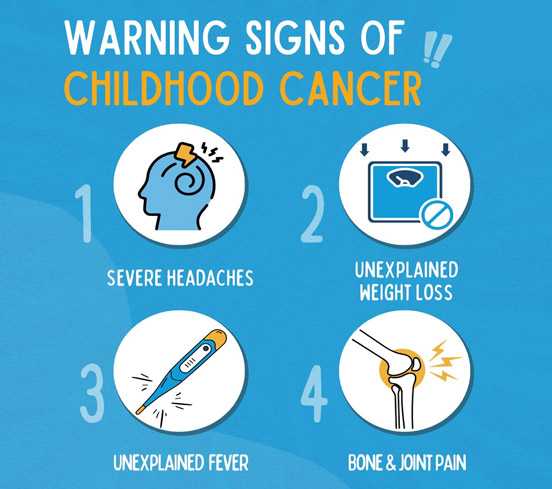
Families and healthcare professionals play a key role in spotting the early signs of childhood cancer. (Infographic courtesy: WHO)
Geography and financial burden
Access to care is shaped by geography. Most specialist centres and paediatric oncologists are in large cities. Rural families undertake long, costly journeys for diagnosis, only to face crowded wards and limited child-friendly support. Treatment typically lasts two to three years, involving chemotherapy, monitoring and rehabilitation. Families spend ₹10-20 lakh, often exceeding their annual income.
The story of four-year-old Devansh Das illustrates this burden. Diagnosed with blood cancer during the pandemic, his family travelled from Baleshwar to Bhubaneswar. The treatment cost ₹15 lakh, forcing them into debt. While loans and help from relatives keep treatment going, the strain is immense.
Insurance gaps
Financial protection remains inadequate. Existing insurance schemes cover only a fraction of the costs. Diagnostics, repeat admissions, infection management, nutritional support, counselling, and long-term follow-up often fall outside packages. Girls are diagnosed later due to cultural neglect, while children from marginalized groups face higher rates of treatment abandonment. In some households, expensive cancer treatments for girl children continue to be seen as a sunk cost.
Integrating childhood cancer into national programs
India has introduced measures to improve care, but they remain fragmented. Childhood cancer must be fully integrated into national programs so it becomes part of routine child health services. Ayushman Bharat can expand coverage to include diagnostics, nutritional support, infection management, supportive medicines, palliative care, and travel assistance. Five-year follow-up coverage would prevent families from abandoning treatment.
Rashtriya Bal Swasthya Karyakram (RBSK), which screens children for birth defects and diseases, can add cancer warning signs to its list. Early detection through Anganwadi centres, schools, and community outreach, supported by referral pathways and data sharing, could transform outcomes.
National Health Mission (NHM) can equip district hospitals with diagnostic facilities, link rural doctors with specialists, expand cancer registries to include childhood data, and introduce paediatric oncology modules in medical education. Counsellors, social workers, and nutrition experts funded under NHM can support families through long treatment journeys. Integrating childhood cancer into these programs would create a continuum of care from recognition to treatment, recovery and rehabilitation, ensuring no child is denied treatment due to geography or income.
Community awareness
Awareness is critical. Parents, teachers, Anganwadi workers and primary care doctors must recognize early warning signs. District hospitals must confirm diagnoses, while telemedicine can connect local doctors with specialists. Above all, children and families must be treated with dignity, empathy and sustained support.
A call to action
On this World Children’s Day, India must confront an uncomfortable truth: childhood cancer is not a rare tragedy but a growing public health challenge. It demands political commitment, public investment and national urgency. The right to survival and development must shape policies and budgets. A nation is measured not by how it treats its privileged citizens but by how it protects its most vulnerable. India’s children deserve not just survival, but the chance to thrive. On this day, let us pledge: no child with cancer will be forgotten.
(Dr Urvashi Prasad is a former Director, NITI Aayog and a Senior Fellow at Pahlé India Foundation. Ankeetaa Mahesshwari is an Associate Fellow at Pahlé India Foundation, a New Delhi-based Think Tank.)