By Vipul Tamhane
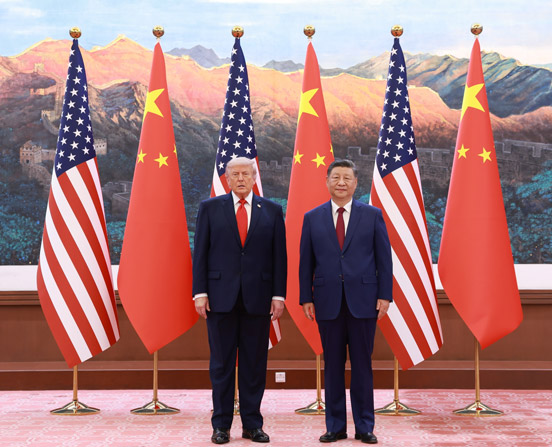
There is an old diplomatic maxim that the real deals at a summit are never the ones announced at the podium. Donald Trump's three-day sojourn to Beijing in mid-May, flanked by Silicon Valley's most powerful CEOs and a Secretary of Defense whose very inclusion broke decades of protocol, was a masterclass in that principle.
What was billed as a trade offensive ended as something far more consequential: a quiet reordering of global power dressed up in the language of commerce.
Two threads run through this visit that deserve far more attention than the headline-friendly optics of Elon Musk and Jensen Huang clinking glasses in Zhongnanhai. The first is the emergence of China as the world's pre-eminent capital allocator, not a supplicant seeking market access, but a sovereign creditor whose goodwill the West now courts.
The second, and more historically charged, is the quiet crystallization of what might be called a "conflict management condominium" between Washington and Beijing, a bilateral framework for deciding, between themselves, where crises will and will not be allowed to escalate.
Together, these two threads do not merely describe a diplomatic moment. They announce the shape of the world that comes next.
Strategic tributary economics: The wheel turns
When US Deputy Secretary of State Christopher Landau warned at the Raisina Dialogue in March that America would not repeat "the same mistakes with India that we made with China 20 years ago", he was offering an honest autopsy of a policy that invited China into the World Trade Organisation, supplied it with capital, technology, and market access, and watched it become a civilizational competitor.
The admission was striking in its candour. What was more striking, just weeks later, was watching the United States repeat the exercise, this time without even the ideological alibi of "engagement theory."
Trump's CEOs did not travel to Beijing to bargain. They travelled to explore, to court, to signal availability. In a world where American fiscal credibility is increasingly strained, where the Iran conflict drained military prestige, and where the trade surplus China has run against the United States now exceeds $8.9 trillion across two decades, the power geometry has quietly inverted.
Washington once allocated capital to Beijing. Today, Beijing's largesse, its market, its manufacturing, its willingness to invest in "non-sensitive areas", is what Washington is angling for.
This is the logic of what one might call Strategic Tributary Economics: a relationship in which the nominally dominant power must periodically make the journey to the court of its creditor-rival, bearing gifts of market access and diplomatic concession, and return with promises that may or may not materialize.
China pledged $250 billion in US investments during Trump's 2017 Beijing visit. None of it was realized. The current summit produced a vague mention of a bilateral investment board. The pattern is consistent: America seeks compensation; China offers process.
What gives this dynamic its structural character is not malice but efficiency. American and Western corporate assessments consistently rank China as more investor-friendly, with tax holidays, land grants, energy subsidies, and the administrative certainty of a party-state that can clear obstacles overnight.
India, the obvious democratic alternative, is burdened by labor unrest, regulatory friction, and the productive chaos of democratic contestation. In the cold calculus of capital, China wins. And so the CEOs fly east, and the tributary logic compounds.
The darker dimension of this model is visible in places like Brazil, where BYD's contractors imported workers under conditions the Brazilian Labour Ministry described as "slavery-like."
What functions smoothly inside China's state-mediated labour ecosystem, the Zhengzhou gigafactory with its party-owned land, captive dormitories, and nine-to-nine work culture, becomes legally precarious when exported. But this does not diminish China's drawing power. It merely reveals the terms of the bargain: access to the Chinese production miracle requires accepting the Chinese model, at least partially, on its own terms.
The condominium of managed conflict
The second, more consequential development from Beijing is one that will not be named plainly by either side, because naming it would require acknowledging what it means for the rest of the world.
Xi Jinping's invocation of the "Thucydides Trap", the structural tension between a rising and a dominant power, borrowed from the collision of Athens and Sparta, was not an academic flourish. It was a negotiating frame. Xi has deployed this reference in 2013, 2015, 2023, and 2024. Its reappearance in the Trump meeting signals something deliberate: Beijing is offering Washington a narrative for retreat that does not require the word "retreat."
The formulation China is proposing, a "constructive China-US relationship of strategic stability", is the language of condominium. It echoes Hu Jintao's 2006 desire for "long-term and stable constructive" relations, and Xi's own earlier suggestion of a "G2", a world managed bilaterally by its two superpowers, with other nations accommodating the resulting settlements. What has changed is that the United States is no longer in a position to resist this framing.
Trump's acknowledgment that America is unwilling to fight "9,500 miles away" in the Taiwan Strait is the most consequential sentence spoken by an American president on Asia policy in a generation. Marco Rubio's insistence that US policy on Taiwan was unchanged fooled no one in Taipei, Tokyo, or New Delhi.
The Iran episode illuminates the logic further. With American power depleted by the Iranian conflict and Washington dependent on Chinese (and Pakistani) mediation to stabilize the Hormuz Strait, the joint communiqué on Iran's nuclear program and freedom of navigation was not a shared triumph. It was more of a demonstration of the new operating system.
Washington and Beijing will manage crises together, bilaterally, while other powers accommodate the outcomes, more or less. The inclusion of a Secretary of Defense in a presidential China visit, unprecedented since 1972, also sort of underscores that the military-to-military channel Xi signalled is being opened in earnest.
What comes next
The world that emerges from Beijing in May 2025 is one where the tributary logic runs both ways, and where the G2 that Xi Jinping proposed over a decade ago has quietly arrived not through proclamation but through accumulated fact.
For middle powers, India foremost among them, the imperative is urgent and uncomfortable.
The choice is not between the American order and the Chinese order. It is between building genuinely independent capacity, economic, technological, diplomatic, or being accommodated within a bilateral framework designed without them.
India, with its democratic friction and its refusal of Chinese investment terms, is already half-excluded from both models. That exclusion could be a strategic liability or, if treated with some imagination, it could become a bedrock for a differently built coalition.
The Beijing summit will be remembered, if it is remembered at all, not for the agreements that were signed, but for the agreements that were not, and for what that gap disclosed about who, today, holds the initiative.
-------------------------------------------------
(Vipul Tamhane is a counter-terrorism expert and governance consultant)
The views expressed are not necessarily those of The South Asian Times