By Bhuvan Lall
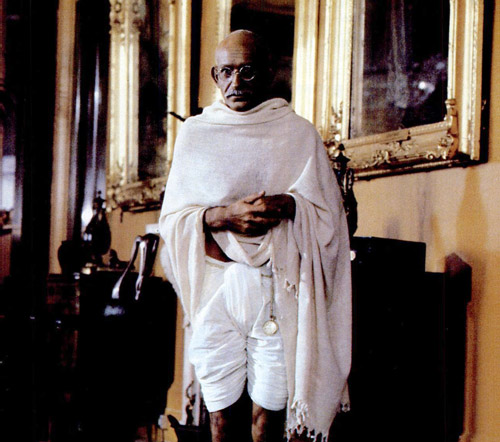
Monday, April 11, 1983, was the biggest night in Hollywood. All eyes were focused on the Dorothy Chandler Pavilion in Los Angeles for the 55th Academy Awards. Half a billion people watched on television as the nominees for the best actor were announced - Peter O'Toole, Paul Newman, Jack Lemmon, Dustin Hoffman, and Ben Kingsley. John Travolta opened the envelope. The winner was Ben Kingsley, for 'Gandhi'.
The Academy, a body of 3,953 professionals, had voted for Kingsley for his remarkable recreation of the young Indian lawyer as he moved through history to be a symbol of peace and non-violence. The orchestra played an Indian hymn, ‘Raghupati Raghav Raja Ram,’ one of the hymns closely associated with the Mahatma. The audience applauded as Kingsley, in a white evening jacket, walked on to the stage to receive the award. Admitting he was overwhelmed to be mentioned in the same breath as the other four gentlemen who were nominated with him, the Academy Award winner added, “This is an Oscar for vision for courage and for acting and for peace”.
The film had been the obsession of filmmaker and actor Richard Attenborough since 1962, when he had read Louis Fischer's biography of Gandhi in the comfort of St. Moritz. The obstacles he met were formidable. Financiers turned the project down multiple times. When the funding of $22 million was finally secured in 1981, the question of the actor remained. The investors wanted a Hollywood star to de-risk the high-budget enterprise. Attenborough, who had earlier seen the little-known 38-year-old actor Ben Kingsley play Hamlet, invited him for a screen test.
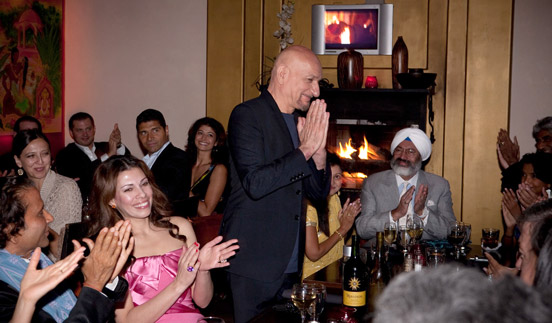
Sir Ben Kingsley at a dinner organized in his honor at Nirvana restaurant in Beverly Hills.
Kingsley had come into the world as Krishna Bhanji. His grandfather had left Jamnagar, in Gujarat, been shipwrecked off Zanzibar, and been taken in by a spice merchant. His father, Dr R H Bhanji, born in Kenya, had trained as a physician and settled in England, where he married an English actress, Anna Lyna Mary (Goodman).
The son was raised in Manchester, given an English education, and expected, as the sons of immigrant professionals are expected, to become a doctor. Instead, the young Krishna gravitated towards dramatics and Britain’s Royal Shakespeare Company. His stage name, Ben, was a tribute to his father’s nickname, while Kingsley was derived from his grandfather’s nickname of "King Clove" and his spice trade business. Ben Kingsley came into the world of theatre with multiple identities that would quietly define his life and art.
Attenborough was mesmerized from the moment Kingsley came on the screen test. It was, in its way, a remarkable situation. The man who had spent years in obscurity had been chosen to embody one of the century’s defining political figures. The preparation for the role of Gandhi was extraordinary. Kingsley shaved his head, lost twenty pounds, ate no meat, studied yoga, and learned to spin cotton while holding conversations.
He immersed himself completely in Gandhi’s character. Observers on the set were unsettled by the resemblance, approaching a resurrection. He later recalled, “When I was in India, I was so utterly convinced that there was nothing better to do in the whole world than what I was doing then. And such close scrutiny from everyone made me think I owed it to these people to give everything I had.” The results on the screen were startling. 'Gandhi' won eight Oscars. It was reviewed as the most emotionally wrenching movie ever made. The epic movie looks, even now, like something that could not have been made, and yet was.
The global impact of 'Gandhi' and of Kingsley’s performance within it was profound. He became an established film star in Hollywood. Eleven years later, Steven Spielberg, impressed by the British actor of Indian descent, placed Kingsley in a film of a different order entirely – 'Schindler’s List'. Kingsley played Itzhak Stern, the Jewish accountant who understood exactly how to exploit a corrupt arrangement for the preservation of Jewish lives during WW2.
Kingsley, in his watchful stillness, became the moral centre of the entire story. He had been useful again, to history, to memory, to the cinema’s reconstruction of what had been lost. The critical and commercial success of the film led Spielberg to establish the Survivors of the Shoah Visual History Foundation, preserving Holocaust testimonies for future generations.
Some actors inhabit roles, while some actors become them. Kingsley thoroughly dissolves the boundary between self and character that audiences forget they are watching a performance at all. His roles leave marks that do not fade. In the movie 'House of Sand and Fog', Kingsley played Colonel Massoud Amir Behrani, a ramrod-straight, proud Iranian immigrant who was a senior officer in the Shah’s Air Force, but now secretly works two menial jobs to support his family. In a heartfelt rendering, Kingsley as Behrani pauses to look at a photograph of himself with the Shah. In that moment, the pain in his eyes reveals what he has lost since being forced out of his land in 1979. It’s a remarkable performance, a masterclass in restrained, unbending, dignified acting that anchors one of the most intensely passionate films.
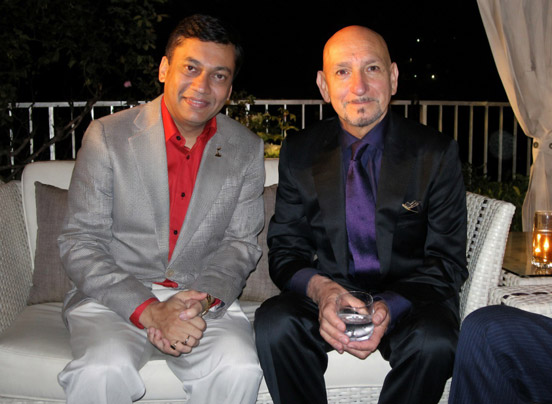
Author Bhuvan Lall with Sir Ben Kingsley.
Kingsley has steadily accumulated awards and honors across the decades. He won an extraordinary record: an Oscar, two Golden Globes, two BAFTA awards, Padma Shri, and further Oscar nominations for 'Bugsy', 'Sexy Beast', and 'House of Sand and Fog'. In 2002, the Queen made him a Knight Bachelor. In May 2010, Kingsley invited me to attend a ceremony on Hollywood Boulevard, as a star (the 2,410th), was set in the famous pink terrazzo, in his name. The ceremony was small, with his wife, Lady Daniela Lavender, his son Edmund, Bruce Willis, Shohreh Aghdashlo, and Jerry Bruckheimer present. Bruckheimer called him one of the finest actors of this or any generation. With the star on the Walk of Fame, Hollywood had adopted him as one of its own legends.
In the warm, spiced air of a Beverly Hills evening, the celebrations continued at an Indian restaurant, Nirvana. Famous restaurateur Deep Sethi and I had organized a dinner in Kingsley’s honor. Speaking on the occasion, eminent producer Ashok Amritraj revealed he had the rare privilege of being in the audience at Dorothy Chandler Pavilion in 1983 when Kingsley won the Oscar for Gandhi. Kingsley visibly moved, politely thanked everyone for “this glorious night,” and concluded his thoughts by stating, “Thank you for honoring my wife, my son, my friends, and my family… You are ingrained in my heart just as firmly as my star is engraved on the Walk.”
Sir Ben Kingsley now lives in Oxfordshire. The Oscar for 'Gandhi' is at his home. After acting in over 100 films, he is actively involved in major Hollywood films, notably as Trevor Slattery in the Marvel Cinematic Universe series 'Wonder Man'. He remains the rarest kind of film star: one who understands the weight of what he carries. His heritage, far from limiting him, has given him a breadth of emotional range and a connection to history’s most dramatic human stories that few actors can access. Born in Yorkshire, schooled in Salford, formed at the Royal Shakespeare Company, made famous in Delhi, Britain, Kraków, and Hollywood, he belongs to no single tradition or nation. He belongs to cinema itself.
(All photos courtesy of the author)
(Bhuvan Lall is the biographer of Subhas Chandra Bose, Har Dayal, and Vallabhbhai Patel. He is also the author of Namaste Cannes, India on the World Stage and Delhi in the Era of Revolutionaries. He can be contacted at [email protected])