By K S Tomar
A victory beyond the battlefield
Like a storm that threatened to engulf an entire continent before suddenly giving way to calm skies, the Iran conflict has ended not with military triumph but with diplomacy. The peace agreement signed by President Donald Trump and Iranian President Masoud Pezeshkian in France has averted a wider regional catastrophe, stabilized global energy markets, and produced political winners far beyond the Middle East.
For Trump, the agreement represents perhaps the most significant foreign-policy achievement of his second term. After weeks of uncertainty that rattled markets and raised fears of a prolonged confrontation, the White House can now claim that it prevented a dangerous regional war while preserving American influence. At a time when voters remain concerned about inflation, energy prices, and international instability, the ceasefire provides Trump with a powerful political narrative ahead of the November midterm elections. The image of a president who ended a conflict rather than expanded one is likely to resonate with independent voters and those weary of America's long military engagements abroad.
According to Trump's supporters, the agreement also demonstrates that Washington remains an indispensable diplomatic actor in global crises. Predictions of American decline have circulated for years, yet the Iran settlement underlines a familiar reality: when major international conflicts require resolution, the United States still occupies the central seat at the negotiating table.
Benefits to America
The benefits for the United States extend beyond politics. A prolonged Iran conflict would almost certainly have driven energy prices sharply higher, complicated global supply chains, and increased inflationary pressures. By helping bring the war to an end, Washington has protected both the American economy and the global financial system.
The ceasefire also allows the Trump administration to redirect strategic attention toward its primary geopolitical challenge—China. Rather than becoming trapped in another costly Middle Eastern confrontation, the United States can now concentrate resources on the Indo-Pacific, technological competition, and economic security.
Equally important, the agreement restores America's image as a power capable of combining military leverage with diplomatic flexibility. Critics had questioned whether Trump's confrontational style could produce lasting settlements. The Iran agreement provides the White House with evidence that pressure and negotiation can coexist within a broader strategic framework.
The policy successes often carries greater value when they produce tangible economic benefits at home. If energy prices remain stable in the coming months, the administration will argue that its handling of the crisis prevented a global shock that could have raised fuel costs and renewed inflationary pressures. For a president seeking to maintain political momentum ahead of the November midterm elections, that argument could prove particularly persuasive. Even critics of Trump's approach may find it difficult to dispute that the agreement prevented a dangerous escalation whose economic consequences would have been felt far beyond the Middle East.
European governments, many of which had worried about being drawn into another regional conflict, now have greater confidence that Washington remains capable of crisis management. The agreement may therefore strengthen transatlantic cooperation at a time when Western unity has been tested by multiple geopolitical challenges.
Iran's unexpected gains
Contrary to expectations, Iran also emerges from the conflict with significant advantages. The survival of the regime itself will be portrayed domestically as a victory. Despite facing enormous military and economic pressure, Tehran succeeded in avoiding the kind of regime-threatening outcome that many observers predicted during the height of the conflict.
The agreement offers Iran an opportunity to pursue economic recovery, attract investment, and reduce the burden of prolonged confrontation. More importantly, it allows Tehran to present itself to its domestic audience as a resilient power that negotiated from a position of strength rather than surrender.
President Masoud Pezeshkian can now argue that diplomacy achieved what continued warfare could not. The ceasefire, therefore, strengthens pragmatic political forces within Iran while reducing the immediate risks of further escalation.
Iran's gains are not merely political. The end of hostilities opens a window for economic normalization and greater engagement with regional neighbors. Businesses and investors that had adopted a wait-and-watch approach may now reassess opportunities in the Iranian market. While sanctions-related challenges remain, the reduction in military tensions alone represents substantial relief for an economy that has endured years of pressure. Equally significant is the possibility that Tehran can now devote greater attention to domestic economic reforms rather than crisis management.
The fallout for Asia and Europe
The benefits are equally significant for Asia. Countries such as India, China, Japan, and South Korea depend heavily on energy imports from West Asia. Stability in the region translates directly into lower economic uncertainty, reduced inflationary pressure, and greater confidence among investors.
For India, the ceasefire removes a major source of concern. New Delhi's economic growth ambitions depend upon predictable energy supplies and stable trade routes. A prolonged conflict would have complicated both.
For Asia as a whole, the ceasefire removes a major source of uncertainty from an already fragile global environment. China, Japan, South Korea and India all have a direct stake in uninterrupted energy flows from West Asia. Stability in the Gulf reduces the risk of supply disruptions and supports economic growth across the continent. The agreement, therefore, serves as an economic stabilizer for some of the world's largest and fastest-growing economies.
Europe may be an even bigger beneficiary. European economies have struggled with successive crises, from the Ukraine conflict to inflation and energy insecurity. Another major war affecting oil and gas supplies would have intensified those pressures. The ceasefire, therefore, provides a welcome economic and strategic respite for European capitals already dealing with multiple geopolitical challenges.
Europe also benefits because the agreement lowers the possibility of another refugee crisis or energy shock at a time when the continent is still coping with the consequences of the Ukraine conflict. In many respects, the ceasefire is not simply a regional settlement but a stabilising event with global economic implications.
Pakistan's moment—but not its victory
Against this larger backdrop, Pakistan's role should be viewed in perspective. Islamabad undoubtedly gained diplomatic visibility by facilitating contacts that contributed to the negotiations. For a country often associated internationally with political instability and security concerns, the opportunity to participate in a successful peace process carries obvious value.
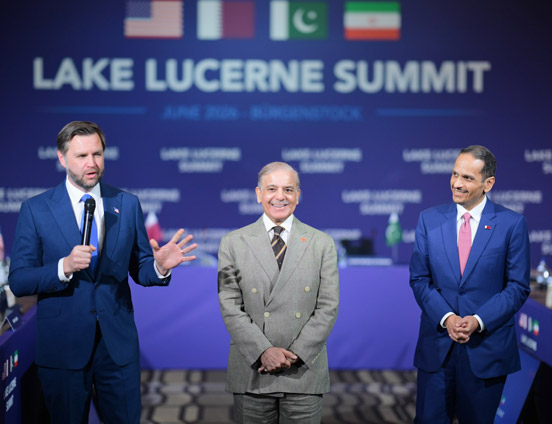
Yet Pakistan's triumph remains incomplete. Islamabad had hoped that its mediation efforts would culminate in a globally visible signing ceremony that would symbolically validate its role. Instead, Trump and Pezeshkian signed the agreement in France during the G7 Summit. The defining images of peace belonged to Washington, Tehran, and Paris—not Islamabad.
Even more significantly, Qatar increasingly emerged as the country receiving international credit for facilitating the final phase of diplomacy. Pakistan, therefore, finds itself in the unusual position of being recognized for its contribution while remaining absent from the diplomatic photograph that history is likely to remember.
Pakistan's leadership will nevertheless seek to convert this moment into a broader diplomatic opportunity. The country has long struggled to overcome international perceptions shaped by terrorism, political instability and economic fragility. Participation in a successful peace initiative offers Islamabad a chance to project a different image. Whether that image endures, however, will depend less on one diplomatic episode and more on Pakistan's future conduct and policy choices.
Beyond the headlines
The Iran ceasefire may ultimately be remembered as far more than the end of a regional conflict. It has provided Trump with a significant diplomatic achievement, delivered economic reassurance to global markets, offered Iran a path toward stability and reduced strategic anxieties across Asia and Europe.
Pakistan may have enjoyed a brief moment in the diplomatic spotlight, but the larger story belongs to Washington and Tehran. The agreement demonstrates that diplomacy remains capable of achieving outcomes that military power alone often cannot. It also underscores a broader reality of international politics: nations are ultimately judged not by their participation in negotiations but by their ability to shape the final outcome.
For the United States, the peace agreement represents both a strategic success abroad and a potential political dividend at home. For the wider world, it offers something even more valuable—a respite from conflict and an opportunity to focus once again on growth, stability and cooperation rather than war.
-------------------------------------------------

(K S Tomar is a strategic affairs columnist and senior political analyst based in Shimla.)
The views expressed are not necessarily those of The South Asia Times