By Vipul Tamhane
Foreign policy is rarely made in state capitals. But it is often unmade there. The New Delhi "Neighborhood First" policy has faced its most difficult challenges during the last ten years because state governments opposed the central government's border security measures, and regional leaders used Sri Lankan fishermen's rights to advance their domestic political goals, while chief ministers maintained cultural ties to Bangladesh, which surpassed their national strategic obligations.
The 2026 Assembly elections have, in one sweep, restructured that obstacle course in ways that will reverberate well beyond the borders of the states that voted. The results combined show that India has experienced its biggest political transformation at the state level since the previous generation.
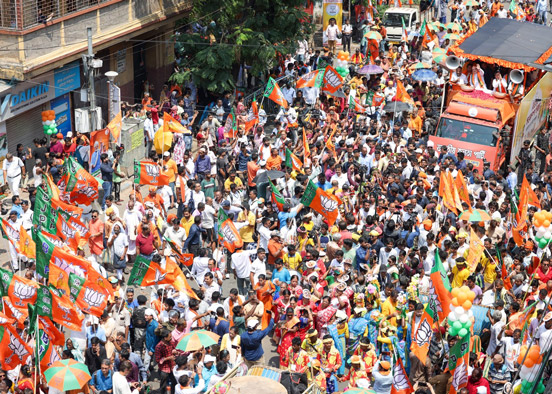
The BJP established its first West Bengal government after winning 206 seats, which allowed it to control the eastern gate from TMC for the first time in fifteen years while maintaining its electoral victory in Assam for the third consecutive election.
The Congress-led UDF has regained power in Kerala after defeating the CPI(M) Left Front government, while actor Vijay's Tamilaga Vetri Kazhagam (TVK) political party has disrupted the DMK-AIADMK political alliance, which has controlled Dravidian politics since 1967 in Tamil Nadu. The AINRC party, which operates as an NDA alliance partner, continues to control Puducherry.
The opposition network that once connected Kolkata to Thiruvananthapuram has discontinued its operation, which creates a need to study the resulting strategic impacts.
Start your analysis from the eastern region because this area has the most important impact on South Asian diplomatic ties. India's eastern border stands as one of its most geopolitically critical borders, which extends 4,156 kilometers through its boundary with Bangladesh, Myanmar, Bhutan, and Nepal, while the Siliguri Corridor, which people commonly call the Chicken's Neck, serves as the main connection between Northeast India and all other parts of the country.
The strategic management of this corridor became difficult for several years because the West Bengal government, which controlled the area through which it passed, maintained diplomatic ties with Dhaka based on cultural factors instead of military needs.
Chief Minister Mamata Banerjee's TMC had deep roots in the Bengali-speaking world that straddled both sides of the border, and those roots sometimes pulled against New Delhi's harder-edged approach to Bangladesh. That friction is now gone. With both Assam and West Bengal under the BJP governments, India has, for the first time, a unified political command structure across its eastern frontier.
Given the current coolness in India-Bangladesh relations, following the political upheaval in Dhaka and New Delhi's 50 per cent cut in bilateral aid, this alignment matters enormously. Having a West Bengal government that supports rather than complicates the Centre's border fencing program, that cooperates with BSF operations rather than treating them as political intrusions, and that does not use Petrapole and other border posts as patronage-dispensing networks, changes the operational reality of India's Bangladesh policy. The Centre can now maintain its "strategic firmness over soft gestures" posture without a state government actively undermining that posture in public.
The alignment enables eastern corridor access, which will now support the infrastructure development program that has remained inactive because of political disputes. The Bharatmala highway network and the Brahmaputra inland waterway projects, and India's plans for the India-Myanmar-Thailand Trilateral Highway require state-level cooperation to obtain land and maintain security.
The "Act East" policy now possesses the required state infrastructure because Assam already serves as a dependable partner, and Bengal has joined the partnership. India's connectivity ambitions in Southeast Asia, long treated as a foreign policy priority with domestic governance gaps, may actually begin to close.
The southern picture is more textured and more interesting. The Congress-led UDF in Kerala now governs the state after the CPI(M)-led Left Front lost power. The Left Front opposed India's Quad alliance and its defense treaties with the United States and all other aspects of Indian foreign policy, which it viewed as Western strategic alignment.
The Thiruvananthapuram Congress government operates as a national opposition, whereas its opposition faces the changes, bringing minor effects as it eliminates an outspoken anti-Centre speaker who questioned security and strategic matters, while it supported illegal entry of immigrants from Bangladesh to swell up its vote bank.
Tamil Nadu is the genuine unknown. TVK's emergence as the dominant force in the state is historic, but its foreign policy implications are, at this stage, essentially unwritten. The DMK under Chief Minister M K Stalin was assertive but predictable on the issue that most defines Tamil Nadu's engagement with South Asian affairs: the rights of Tamil fishermen operating in disputed waters off the Sri Lankan coast. Stalin's government could be counted on to mobilise domestically, apply pressure on New Delhi, and maintain a consistent, if sometimes inconvenient, Tamil nationalist position on Colombo.
TVK has no documented track record on this issue. Whether the new government will be more pliable or merely less vocal on Sri Lanka remains to be seen, but the fragmentation of Dravidian politics does reduce the coherence of the pressure that Tamil Nadu could historically apply on New Delhi's Sri Lanka diplomacy. For the Centre, that is an opportunity. For Tamil fishermen, it is an open question.
Economically, the elections have created a more stable investment corridor across India's east. The central government's infrastructure initiatives experience historical delays, which state governments remove through their system of executive coordination.
The South Asian economic slowdown, the World Bank predicts, as regional growth declines to 6.3 per cent during 2026 because of energy disruptions, makes it more important for India to develop its eastern logistics network.
Border states remain peaceful, which protects against dangerous situations that arise from unrest in Bangladesh and Myanmar because they stop refugee flows and prevent smuggling and organized crime that operate through unsecured border areas.
The BJP political party has built its power during elections but this achievement brings new dangers for the party. The loss of Mamata Banerjee and M K Stalin as powerful regional voices not only weakens the opposition's foreign policy counter-narrative, but it also removes two leaders who, whatever their other faults, had genuine roots in communities whose concerns about India's neighborhood policy were substantive, not merely rhetorical.
The democratic value of a Bengali chief minister who understood Dhaka's street politics, or a Tamil chief minister who understood the lived experience of fishermen risking their lives in the Palk Strait, is not negligible.
A foreign policy conducted entirely from New Delhi, without the corrective friction of engaged regional governments, is not necessarily a more effective one. It is simply a less contested one.
The 2026 elections have given the Centre a cleaner field. The question of whether it uses that field wisely, to build durable regional relationships rather than simply remove domestic obstacles to its preferred positions, is one that no electoral result can answer in advance.
--------------------------------------------
(Vipul Tamhane is a counter-terrorism expert and governance consultant)
The views expressed are not necessarily those of The South Asian Times