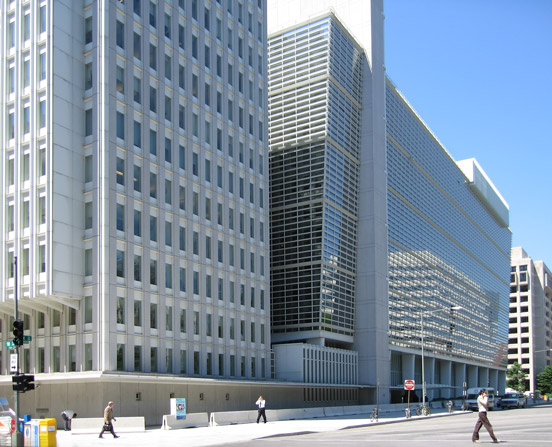
Washington: The World Bank said India is expected to clock a 7.6 percent GDP growth in the financial year 2025-26, while it has raised the country’s growth forecast for 2026-27 to 6.6 percent from 6.3 per cent earlier.
The World Bank Group, in its twice-a-year regional outlook report, stated that "the growth outlook is driven primarily by India’s performance, underpinned by robust domestic demand as well as tariff cuts and recent trade agreements, including the free trade agreement with the European Union".
The report expects growth in South Asia to slow to 6.3 per cent in 2026 -- from 7 per cent in 2025 -- due to disruptions in global energy markets.
The latest South Asia Economic Update, Working with Industrial Policy, projects growth to recover to 6.9 per cent in 2027. The report says, despite the near-term slowdown, South Asia continues to grow faster than other emerging-market and developing economies. Given the region’s reliance on imported energy, driven by India, South Asia’s outlook is vulnerable to spillovers from the current conflict in the Middle East and is exceptionally uncertain.
A prompt resolution would lift growth prospects, while further dislocation in global energy markets could raise inflation, necessitate monetary policy tightening, and dampen remittances.
In addition, global financial turbulence, climate shocks such as the recent Cyclone Ditwah in Sri Lanka, and the impact of AI adoption on service exports could pose further downside risks. The region also needs to accelerate job creation for its expanding workforce, the report stated.
"Despite a challenging global environment, South Asia’s growth prospects remain strong," said Johannes Zutt, World Bank Vice President for South Asia. "Countries need to implement critical policy reforms to sustain growth, create jobs, and increase resilience to shocks. Cross-cutting policies to improve public infrastructure, remove trade barriers, foster business-enabling environments, and mobilise private capital can diversify sources of growth and also create the jobs that are needed to reduce poverty and share prosperity."
The report also includes an in-depth analysis of industrial policy—the range of policy tools governments are using to shape what an economy produces, rather than leaving it to markets alone. Governments around the world are increasingly using industrial policy, and in South Asia, industrial policies are implemented at roughly twice the rate of other emerging economies.
South Asia directs about half of its industrial policy to the manufacturing sector, targeting activities with more employment, higher wages, or larger or more productive firms than in other sectors. But the bigger driver of new jobs outside agriculture has been the services sector, which has rarely been the target of industrial policies.
RBI pegs FY27 growth at 6.9%New Delhi: The Reserve Bank of India (RBI) estimated India’s real GDP growth at 7.6 per cent for FY26 under a new GDP series, while flagging emerging risks from geopolitical disruptions. The FY26 growth reflects resilience supported by strong services activity, manufacturing expansion and robust domestic demand. For FY27, the Central Bank has projected growth at 6.9 per cent, indicating a moderation as external risks and cost pressures begin to build, said RBI Governor Sanjay Malhotra after the MPC meeting. The GDP growth for Q1 FY27 has been revised to 6.8 per cent from 6.9 percent, while Q2 FY27 growth has been lowered to 6.7 percent from 7 percent amid global headwinds due to the Iran war. “Global growth faces increasing downside risks as the sharp rise in energy rises have stoked inflation fears," said Malhotra. The GDP growth stood at 7.8 per cent in the December quarter of FY26, from 8.4 per cent in the preceding quarter. The RBI expects the revival in private sector investment to sustain on the back of high capacity utilisation. Also, food price outlook remains comfortable in the near term, said the Governor. |
Remittances to India likely to touch around $137 bn in FY27New Delhi: Remittances to India are likely to reach an all‑time high of $137–140 billion in FY26 before moderating to $135–137 billion in FY27, amid escalation in West Asia, a report said. Further, enabling true dematerialisation of Retail Direct holdings could boost interoperability and attract strong interest to debt markets from retail investors, the report from SBI Research said. Analysing the language of the central bank governor in the monetary policy meeting, the firm said the recent statement was the most cautious or hawkish out of the last eight statements but did not signal an imminent rate hike. "The choice of words and the latent signal the latest statement carries reflects deep understanding of the evolving geo-economic situation in the world without hinting at any imminent rate hike with regulatory gaze hobbling between growth and inflationary concerns," the report said. |