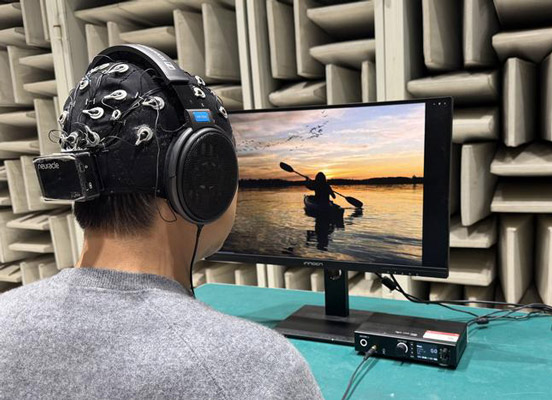
Washington: Most people will close their eyes when trying to concentrate on a faint sound. Many of us have been told that keeping our eyes closed helps us hear better — that it frees up our brains’ processing abilities and increases our auditory sensitivity. However, that strategy may sometimes backfire, particularly in environments with a lot of loud background noise.
In the Journal of the Acoustical Society of America (JASA), published on behalf of the Acoustical Society of America by AIP Publishing, researchers from Shanghai Jiao Tong University tested whether a person closing their eyes can really hear better in noisy environments.
To test this, volunteers listened to a collection of sounds through headphones amid background noise. Then, the volunteers adjusted the volume of the sounds until they could barely make them out over the background noise.
This test was conducted first with eyes closed, then with eyes open but looking at only a blank screen, then looking at a still picture corresponding to the sound, and finally, looking at a video matching up with the sound they were trying to hear.
“We found that, contrary to popular belief, closing one’s eyes actually impairs the ability to detect these sounds,” said author Yu Huang. “Conversely, seeing a dynamic video corresponding to the sound significantly improves hearing sensitivity.”
“In a noisy soundscape, the brain needs to actively separate the signal from the background,” said Huang. “We found that the internal focus promoted by eye closure actually works against you in this context, leading to over-filtering, whereas visual engagement helps anchor the auditory system to the external world.”
The researchers plan to continue their work exploring the relationship between vision and hearing.