By Basab Dasgupta
The US Citizenship and Immigration Service (USCIS) has recently proposed that a person on a non-immigrant visa must go back to his/her country before applying for a green card from that country. This made me reminisce about the unusual set of circumstances that enabled me to get my green card.
Richard Dittman was the chairman of the physics department at the University of Wisconsin-Milwaukee, where I was a PhD student on a student visa. He was a popular undergraduate teacher and motivated in career aspirations; rumor was that he already had eyes set on becoming a dean.
Dittman taught a course, "Physics for Non-Science Majors," every semester, popular because of the interesting and exciting demonstrations. The Students' Union (SU) sold class notes for undergraduate courses with large enrollments so that students could focus on lectures without worrying about taking notes.
SU paid anyone capable of taking accurate notes and submitting a typed version. One semester, I applied and got the job of note-taking in Dittman's course.
The classes were entertaining and informative at the same time. Many demonstrations had a magic-like flare, involving optical illusions and sound effects. Dittman was good at showmanship. I felt a camaraderie with him in our common goal of educating the students. Dittman always smiled and did a little chit chat whenever he saw me.
I was in the process of completing my doctoral research and wanted to continue living in the US. The Vietnam War just ended, and one discussion topic at all gatherings of Indian students was how to apply for a green card.
Being already married, I could not get a green card by marrying a US citizen.
There were only two ways: apply on the basis of "third preference" where one has to convince the USCIS about one’s professional value to benefit society. The other choice was to apply on the basis of "sixth preference"; in this scenario, an employer has to sponsor the applicant by stating that they could not find a qualified US citizen for a critical position. With an abundance of PhD physicists available, this option was also not viable.
Since the third preference application was my only hope, I put all my credentials together and prepared an impressive application package. I had two published papers, one conference presentation, and a summary of the thesis ready, plus a perfect GPA and excellent score in the PhD qualifying examination.
As an "icing on the cake," I decided to submit two letters of recommendation even though those were not required by USCIS. I chose my thesis adviser, Donald Beck, as one of them. I thought that a letter from Dittman would enhance my application.
Dittman seemed to like me; I asked him one day if he would write a recommendation letter after I explained my situation. His response confirmed my expectations. "Oh sure," he said, "I will be happy to".
The two recommendation letters were sent by them to USCIS directly. I put together everything else with a cover letter expressing my intention of devoting my knowledge to the good of the country. The rest was a matter of long waiting.
A large envelope arrived from USCIS only after a month, with a letter inside stating that some information was missing from my application. I do not remember if it was a transcript or some interim address. They returned my entire application package (hence the large envelope) with instructions to resubmit it with the missing information. Surprisingly, the envelope also contained the two recommendation letters that I had not seen before! Naturally, I read both letters right away.
Beck's letter was a decent letter expressing confidence in my abilities and offering praise for my accomplishments. Dittman's letter was not even a recommendation letter; it was an "anti-recommendation" letter. He did not mention anything personal about me, but here is a summary:
"These students come for graduate study in the USA from foreign countries with the stated goal of receiving higher education and taking that knowledge back to their own countries to benefit their motherlands. However, after living here for a few years, they all decide to stay here, effectively causing a brain drain from their own countries and adding to the pool of PhD students already seeking employment here. I do not subscribe to this process and cannot recommend Mr Dasgupta for the green card".
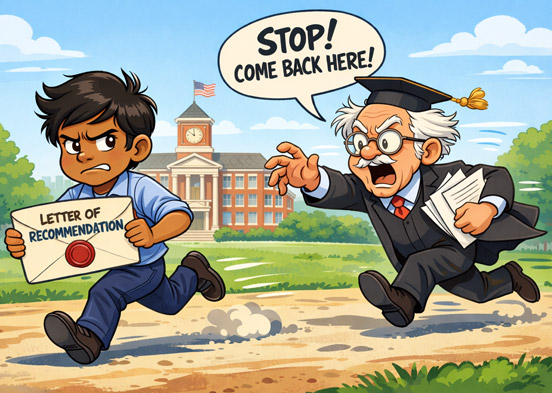
I was outraged. Dittman was entitled to his opinion, but he tricked me by showing his eagerness to write the letter when he knew all along that he would stop my efforts. He could have excused himself by telling me the truth; I could have gone to other professors for a letter. I went straight to his office, closed the door, and sarcastically said, "Well, I now know what you really wrote to USCIS," waving the letter at him.
He was upset; he stood up from his chair and charged towards me by throwing himself across his large desk. I ran into the adjoining conference room and started to circle the long table as Dittman chased me. It was comical that the chairman of a department literally chased its best student for a piece of paper!
Eventually, he caught up with me, running faster with his long legs. He was also strong enough to snatch the letter away and tear it into pieces! I stormed out, not quite knowing what to do.
I sat down in my office for a while trying to grasp what had just happened. I remembered the entire letter word for word; the first thing I did was to recompose the letter and make copies. Then I informed Beck about what happened.
Beck was a real gentleman, almost timid in a situation like this. I was not expecting him to fight on my behalf. I approached a couple of more influential professors – Moises Levy, an experimental solid state physicist, active in the national IEEE organizations, and Leonard Parker, a Harvard graduate, well-known in the field of research on gravitational theories.
I told them what happened and handed out copies of my reconstructed letter from Dittman. They were shocked and assured me to help me get through this.
I do not know what took place behind the scenes, but there were several closed-door meetings between various faculty members to discuss my issue with Dittman.
In the end, several faculty members (including Levy and Parker) offered to write glowing recommendation letters on my behalf; I took them up on their offer. My application package was completed and resubmitted. To make a long story short, my application was eventually approved. I received a green card on my own without sponsorship from an employer or help from any immigration lawyer, long before I completed my PhD.
In my life, I have faced other similar hurdles with unfavorable and unexpected events, but then these undesirable developments eventually turned out to be helpful in overcoming the roadblocks.
I now have the following philosophy in life: I view every apparent bad news as good news! The bad news is almost a test to see how strongly I cherish something before I get it.
----------------------------------------
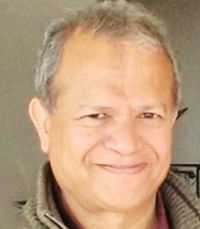
(California-based Basab Dasgupta has a doctorate in Physics from the University of Wisconsin and has worked with Sony as Vice President of an operating division.)