By Basab Dasgupta
I fell in love with everything about the United States of America within a short period after coming here more than half a century ago. My reason was a lot more than comfort and convenience; it was compatibility with my personality and perspective towards life.
I intended to get completely assimilated into American society. The five magic words for me were in that pledge: "Liberty and Justice for All”. I wanted to be an American.
During the 250th birthday celebration of the country, it was my time for introspection about how my life has progressed over the past 55 years. Have I become an American? I must confess that, despite my academic and professional success and outward appearance of living an American life, I do not feel that I have become a “regular” American.
It has nothing to do with my skin color, foreign accent, religion, or other cultural/ideological reasons. I attribute my failure to become an ordinary American to my inability to accept a trifecta of American “norms” in my social life: casual intimacy, consumption of alcohol, and use of drugs.
Please do not get me wrong; I am neither a puritanical nor a religious person. I married young, subsequently got divorced, and later lived with a Caucasian woman. I do drink alcohol but have never tried any recreational drug.
It has always puzzled me to see that when an American man meets an American woman, physical intimacy is very much on the minds of both regardless of their age, marital status, physical attributes, and venue of the meeting.
Furthermore, they will not hesitate to take advantage of any opportunity to explore if an initial attraction leads to something more. Consumption of alcohol diminishes their inhibitions. This can lead to infidelity, divorce, various unpleasant situations, abortion, diseases, neglect of young children, and hasty marriages.
Once a couple starts dating seriously, they get married quickly, and if a marriage does not seem to work, they also get divorced quickly. This behavior pattern runs across the entire social strata and political spectrum, from John F Kennedy and Bill Clinton to Donald Trump and Newt Gingrich.
During my post-divorce period, I tried to enter the dating scene. My effort to impress women with my intellectual traits rarely worked. I did not know what to say, what to do, when to make a move, and where to go. My awkwardness in dancing did not help the situation.
My difficulty was enhanced by my emotional state. I never understood “casual affair” with “no strings attached”. Not only do I get emotionally involved, I always worry about the woman’s emotions. This “baggage” was always a deterrent for me to marry someone new and live happily ever after.
It always surprises me how most Americans take their ex-spouses or ex-partners completely out of their lives after a split. They do not seem to get emotionally attached regardless of the length of their marriages and initial passion. I am shocked by the amount of animosity, if not hatred, that often exists among many divorced couples.
I enjoy alcohol on special occasions. There is nothing better than a glass of Merlot with a fancy Italian dinner. My favorite drink during business travel was Bourbon and 7-up. An after-dinner drink of Kahlua or Baileys Irish Cream is a wonderful way to finish a meal. However, I never get addicted, never get drunk and never feel the need for alcohol to complete my dinner.
Alcohol consumption in this country is increasing. Aisles and aisles in grocery stores are stacked with bottles of alcohol; rows of endless bars/restaurants serve alcohol on any busy street. No matter where you go, an alcoholic drink is within easy reach. It is a given that alcohol must be served at any gathering.
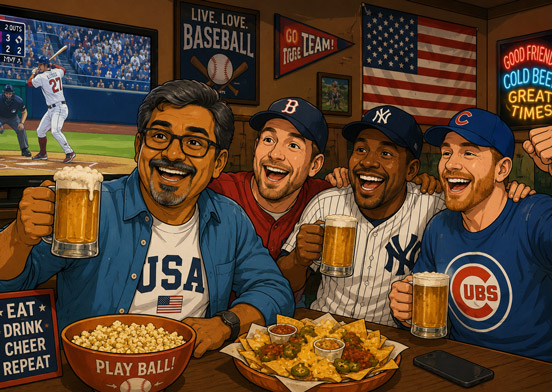
“Girls night out” means “girls drinking alcohol”. “Watching a ball game with guys” is synonymous with “watching and drinking beer”. Being frugal by my Indian upbringing, drinking alcohol also seems to be wasting money. Why drink a $12 glass of wine when I can drink a glass of Coke for $3?
I am expected to know and memorize not only names and varieties of various wines and hard liquors but also mixed drinks. Examples are: “Daiquiri”, “Mojito”, “Piña Colada”, “Mai Tai”, “Long Island Iced Tea”, “Mimosa " etc.
Of course, a person has a right to drink whatever he/she feels like if they can afford but I draw the line where it leads to irrational, embarrassing behavior in public, spousal abuse, car accidents, and health issues such as liver damage.
Addiction to drugs is a separate issue from addiction to alcohol. Drinking alcohol is an open secret; everyone drinks, and the only question is how much. Not everyone takes drugs, and even fewer admit to taking it.
My discomfort lies in the acceptance and tolerance of those who take drugs. I have zero tolerance and do not know how to deal with drug addicts. I would rather not allow such people into my house nor even interact with them at social gatherings.
Many Americans I meet in social and professional circles openly admit to having tried “pot” or marijuana. Recreational use of prescription pills is now an acceptable practice, especially among the younger generation. These pills offer a transitional step to harder drugs, especially if mixed with alcohol.
Numerous accidental deaths from overdose do not seem to be a deterrent. No one publicly admits to taking hard drugs like cocaine or heroin, but I see “stoned” people at parties; they behave like zombies and not like themselves.
This is the key point. I believe that people do drugs and alcohol because they want to metamorphose into someone else so that they can say or do whatever they please, hiding behind a facade. I never felt that need. I am content and happy with who I am.
If my American friends in any gathering find out my views described here, I will probably not be accepted as an American and regarded as a stereotypical ethnic Indian. No one says it explicitly, but it will be apparent from their comments and jokes, looks, and body language. They would carry out their interactions, leaving me out. Sadly, the trend among younger generations in all three behavior patterns is for the worse.
Many of my Indian friends pretend to be wine and alcohol connoisseurs as a symbol of their Americanization but otherwise live an “Indian life”; eating Indian food, watching Bollywood movies, socializing with other Indians, attending religious festivities, making annual trips to India, and so on.
I do not want to be like them because I would rather go back to India if I want to live an Indian life.
I still consider myself to be an American; I have embraced the American virtues without the American vices. I wish I could educate Americans that there is a way to make their lives even better. I will offer them what the Indian holy men have taught us for centuries: learn to control your urge for instant gratification and tame your senses.
------------------------------------------

(California-based Basab Dasgupta has a doctorate in Physics from the University of Wisconsin and has worked with Sony as Vice President of an operating division.)