By Bhuvan Lall
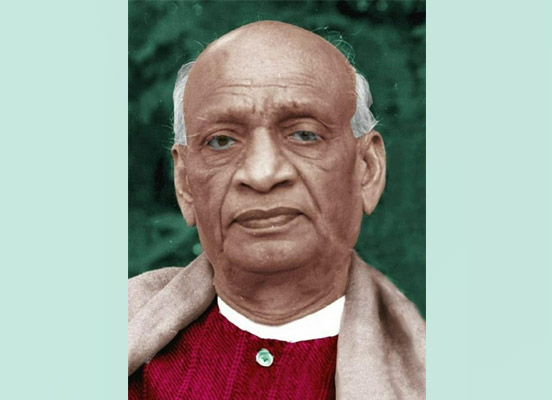
On Tuesday, August 15, 1950, India entered the fourth year of its independence. That morning, farmers from across the nation waited outside a single-story bungalow with colonnades, deep verandahs, domes, and a pillared portico located on Aurangzeb Road in Lutyens’ Delhi. The house had no nameplate. It was the residence of Sardar Vallabhbhai Patel. He occupied just a few rooms in a large house owned by his friend, Banwari Lal. The 74-year-old Deputy Prime Minister, clad in his customary dhoti and kurta, emerged with his devoted daughter Maniben, who wore Khadi and had shared his prison struggles during the freedom movement. Father and daughter patiently heard each petition, embodying an era of simple living, high thinking, and noble ideals. Socialist leader Jayaprakash Narayan later noted, “As compared with the Prime Minister’s mansion, the Sardar’s official residence was modest, though he was not a Socialist.”
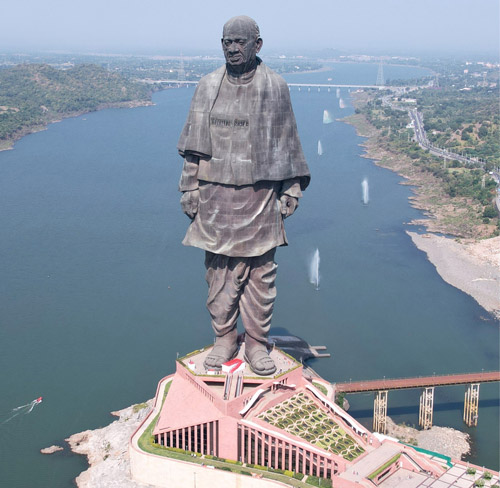
The Statue of Unity in Gujarat honors Sardar Vallabhbhai Patel, the Iron Man of India, who unified the country after independence. (Photo courtesy: Statue of Unity/Facebook)
Rising from humble beginnings, Vallabhbhai inherited his rebellious nature from his father, Jhaveribhai Patel, a farmer who fought in Rani Lakshmibai of Jhansi’s army during the Revolt of 1857. His mother, Ladbai, a follower of Swaminarayan Sampraday, instilled in him a love for ancient Indian epics and a strong desire to fight injustice. The young Vallabhbhai honed his sharp intellect as a rising criminal lawyer in Godhra and later in Ahmedabad.
During a trial in Anand, he heard about the loss of his beloved wife Jhaverba in distant Bombay, and stoically endured the tragedy. He never remarried and raised his children, Dahyabhai and Maniben, on his own. In 1906, Patel gave up the chance to become a Barrister to support his elder brother, Vithalbhai. It wasn’t until he was 35 that he could pursue his dream of studying law in Britain. He completed his Middle Temple qualification in two years, achieving the top score in the Roman Law exams. After that, he never left India again. Gifted with a wise mind and unwavering grit, he quickly established himself as a legal luminary in Ahmedabad. Barrister Patel, a bridge enthusiast, dressed elegantly in tailored suits, and a member of the exclusive Gujarat Club, was on track for a British knighthood.
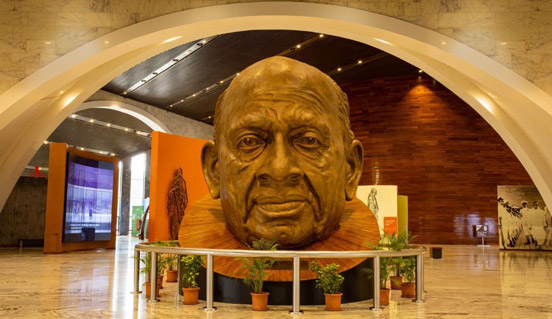
Face of Unity: The bust of Sardar Patel at the Statue of Unity Museum in Gujarat. (Photo courtesy: Statue of Unity/Facebook)
In April 1916, Patel first met another London-trained barrister, Mohandas Karamchand Gandhi, and he dismissed the hero of South Africa as a ‘crank’. Over the next two years, he carefully observed the words and actions of the emerging leader of the Indian masses. Then, in October 1917, the highly anglicized Patel dramatically shed his thriving practice and embraced Satyagraha and Ahimsa, introducing himself as “a blind follower of Gandhi”. In the sweltering heat of Kheda in 1918, Patel defied British might and land revenue laws, unleashing his patriotism, pragmatism, and political genius. From that moment onward, there was no turning back from the nonviolent civil disobedience movement.
Next, the women of Bardoli awarded him the title Sardar after the successful ‘no-tax’ protest in 1928. Gandhi appointed the masterful organizer as his deputy, and the British sentenced both Barristers to long sentences in squalid imperial jails. When threatened with re-arrest, the tireless campaigner quipped, “My bags are packed.” By 1931, his nom de guerre was the ‘Iron Man of India’, and he was elevated as Congress Party President at the 46th session in Karachi. Patel declared, “You have called a simple farmer to the highest office, to which any Indian can aspire.”
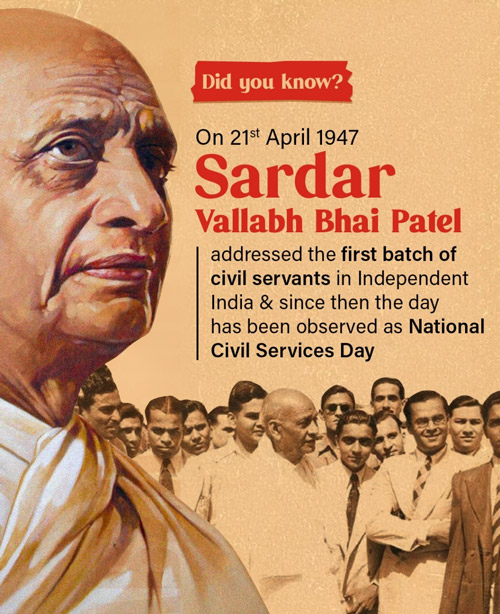
(Graphic courtesy: Ministry of Culture, GoI), IAS (Photo courtesy: X@PIBKolkata)
During those tumultuous years of India’s independence movement, the nation needed someone who would serve as a sounding board for Gandhi’s mysticism, translate Jawaharlal Nehru’s idealism into practical solutions, and effectively resist the rabid fanaticism of Mohamed Ali Jinnah. In the country’s greatest hour of need, Patel emerged as a balanced person who never allowed himself to be defeated by adversity, grief, or turmoil. The architect of Congress’s administrative powerhouse, he seemed destined for the Prime Ministership in April 1946, with a majority of votes cast in his favor. Shockingly, Gandhi anointed the fourteen-year-younger, globally feted Nehru, consigning the 70-year-old Patel to apparent oblivion. But Patel was a stoic doer who, at each stage in his life, managed to arrive at a broader view of things. Earlier in 1945, he organized the defense team for the INA trial at the Red Fort, despite his ideological opposition to Subhas Chandra Bose. He was also the Chairman of the Indian National Army Relief Committee.
On September 2, 1946, Patel took the oath of office, was appointed to the Home portfolio in the interim government, and entered the North Block on Raisina Hill in New Delhi. Despite the complexity of issues facing the world’s seventh-largest nation, Patel was not overwhelmed and proved equal to the task. While Gandhi and Nehru decried the partition of an ancient land, Patel pragmatically accepted the creation of theocratic Pakistan post the fiasco of the Congress-Muslim League interim government.
In August 1947, the British Empire’s hasty and shameful flight suddenly unleashed the bloodiest migration in human history. With cities aflame and anarchy let loose, millions of traumatized refugees and shattered families fled from eastern and western borders. Amid the carnage, many predicted the demise of the Indian Union. Gandhi’s peace mission in Noakhali is legendary, but Patel’s bravery in ending the century’s bloodiest communal frenzy lurks in obscurity. Risking his life, he confronted the genocidal Frankenstein that had overwhelmed the nation, and transformed himself into a giant capable of saving his bleeding, broken country. Keeping all sections of the population in mind, he crafted a realistic strategy to crush riots with an iron resolve and win over disparate groups with understanding and compassion. He spoke softly, but his words carried the weight of mountains.
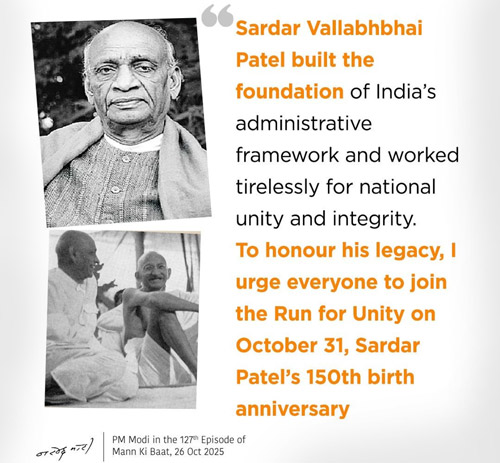
(Graphic courtesy: MyGovIndia)
On September 30, 1947, Patel encountered a mob in Amritsar and spontaneously delivered a speech from a car’s bonnet, imploring the fuming crowd to cease vengeance against Pakistan-bound refugees. That precision-guided, evenhanded oratory averted widespread slaughter on both sides of the border. In Lucknow on January 6, 1948, he confronted zealots eroding interfaith ties and stated, “Ours is a secular state... let us end the era of conflict.” The information ministry, on his orders, intensified a campaign to play down communal differences. His unflinching candor and poise overcame the subcontinent’s savagery and bound up the nation’s wounds in that stormy period.
Patel’s most significant challenge was Winston Churchill’s conspiracy to create ‘Princestan’, a splintered third dominion of 562 autonomous princely states headed by the anachronistic group of princes. The former British PM had scorned granting India independence, calling it a handover to “men of straw.” In the months that followed, Patel worked tirelessly and crisscrossed India to salvage a united India from the wreckage of 1947. Unyielding under pressure, Patel, aided by the astute V P Menon of the Ministry of States, masterfully ensured that the willing rulers and some reluctant states, including Junagarh, accepted the mergers, shattering the imperial Balkanization plot. In October 1947, Jinnah dispatched the military, camouflaged as mercenaries, to invade Kashmir. The resolute Patel did not allow events to overtake him and took command of the situation, declaring, “We shall not surrender an inch of Kashmir territory.” As peril mounted, Maharaja Hari Singh signed the accession document and permitted India to intervene militarily. The valley was saved. Patel arrived in Srinagar and insisted on sending the wheelchair-bound Yuvraj Karan Singh, who was troubled by an immobilized hip, to New York for treatment. Karan Singh later reflected, “I am very grateful to the Sardar... I am personally deeply indebted to him for enabling me to walk again… Otherwise, I may really have been a cripple all my life.”
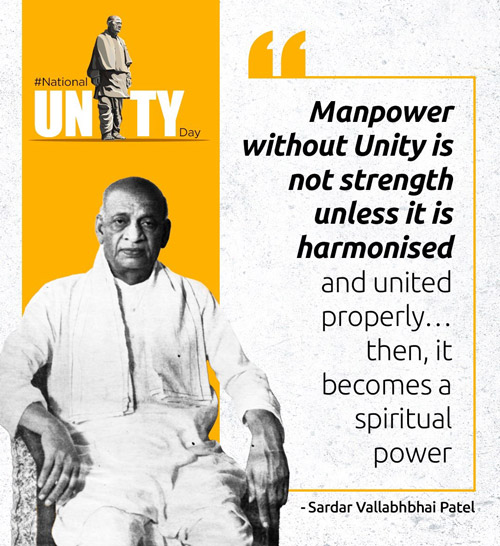
(Photo courtesy: MyGovIndia)
On the cold evening of Friday, January 30, 1948, just as the sun was fading, the lights went out over India as Mahatma Gandhi fell to an assassin’s bullet despite security arrangements. A thunder-struck Patel informed the Parliament, “He (Gandhi) would not agree to anybody being restricted from coming to prayer meetings or anybody being allowed to come between his audience and himself…. To my profound regret and utter sorrow and to the irreparable loss of all of us, the nation and the world, the weak spot that both I and the police had apprehended was deceitfully and successfully exploited by the assassin.” At that time, Patel’s unwavering command proved indispensable, and he remained determined to give no quarter to the anti-national forces. However, his delicate relationship with Nehru had reached a breaking point. Placing national interests first, he silently retracted his resignation. Having survived assassination attempts, a plane crash, a heart attack, and progressive kidney failure, Patel’s mind was constantly occupied sorting out the chaos of post-independent India with clarity, foresight, and patience.
Even one year after India’s independence, Hyderabad’s Nizam, Osman Ali Khan Asaf Jah VII, the world’s richest man, clung to independence dreams, but Patel’s steadfastness orchestrated the merger. The integration of the numerous Indian Princely States into a diverse country of continental size is one of the greatest triumphs in Indian history. Admiring his dauntless colleague’s incredible political tour de force, Nehru stated, “He has drawn the map of free India. He has had a great hand in securing the independence of India and later contributed greatly to preserving it.”
After independence, over 300 million Indians, spanning languages, faiths, ethnicities, and cultures, languished without a democratic constitution. He chaired the Advisory Committee on Fundamental Rights and advocated vital clauses in the constitution that reflected the newborn Republic’s aspirations. The visionary Indian also created a unified public service to knit the world’s largest democracy. Eminent ICS officer L K Jha later recalled that Patel hosted serving senior civil servants at his Aurangzeb Road home and concluded with an inspiring speech, “I am going to rely on the 411 of you to help us in the tasks that lie ahead.”
He established the Indian Administrative Service (IAS) and central cadres as the government’s backbone. On April 21, 1947, at Delhi's Metcalfe House, Patel rallied the inaugural IAS probationers, calling them “the steel frame of India.” In an inspirational address, he stated: “A Civil Servant cannot afford to, and must not, take part in politics. Nor must he involve himself in communal wrangles.” An administrator’s delight, Patel forged bureaucrats into a cohesive force, arbitrating the thorny issue of the partition of assets between India and Pakistan.
Cabinet Secretary Hirubhai M Patel and Pakistan’s Chaudhry Muhammad Ali sealed an equitable accord. At the Partition Council’s final meeting, Pakistan’s Adbur Rab Nishtar lauded Patel's wisdom and magnanimity, vowing his ministers would revere him as an elder brother. Patel humbly redirected the praise to his officials. Hirubhai Patel observed, “Sardar was a realist. He believed in no ‘ism.’ To him, only whatever could be demonstrably proved to be in the country’s interest was acceptable. All else was wrong.” Beneath Patel’s steely demeanor and strict enforcement of law also lay a keen sense of humor and personal discipline.
He undertook predawn strolls in Lodi Gardens, ate little, quit smoking when he first went to jail, and drank no alcohol, epitomizing principled existence. As the campaign fund manager of the party and supporter of the business tycoons J R D Tata, Ghanshyam Das Birla, and Ramkrishna Dalmia, Patel exiled his son, Dahyabhai, and kin from the capital to thwart lobbyists. Even Gandhi had indicated: “Sardar is incorruptible.”
At 74, Patel probably had a premonition about his death, and on August 15th, 1950, in his last address to the nation, stated: “In my life, I have now reached a stage when time is of the essence. Age has not diminished the passion that I bear to see my country great and to ensure that the foundations of our freedom are well and securely laid.” He urged Indians to “sustain the hope and confidence which an old servant of theirs still has in the future of our country.” In a special message to overseas citizens of India, Patel added, “It is for them to carry the fair name of India to the farthest corner of the world and to create around them the maximum of friendship and goodwill. They are the embodiment of India’s culture and traditions, and it is therefore for them to be the living symbols of its glory and greatness….”
Four months later, on the morning of Friday, December 15, 1950, just after 9:30 am, a heart that had been beating for India for decades came to a stop. Death came to the long-ailing Patel. As the news spread, offices, markets, factories, and businesses instantly shut down across the nation as a mark of respect. Over a million people, filled with grief, attended the cremation in Bombay. India’s first President, Dr Rajendra Prasad, wrote, “That there is today an India to think and talk about is very largely due to Sardar Patel’s statesmanship and firm administration.”
Seventy-five years after his passing, a 597-foot-tall statue of Patel, built to withstand hurricanes and earthquakes, stands in Gujarat as a tribute to the man who devoted himself to the peace, prosperity, advancement, and unity of his motherland. Sardar Vallabhbhai Patel remains the standard by which all Indian political leaders will continue to be measured.
-------------------------------------------
.jpg)
(Bhuvan Lall is the biographer of Netaji Subhas Chandra Bose, Lala Har Dayal, and Sardar Vallabhbhai Patel. He can be reached at - [email protected])