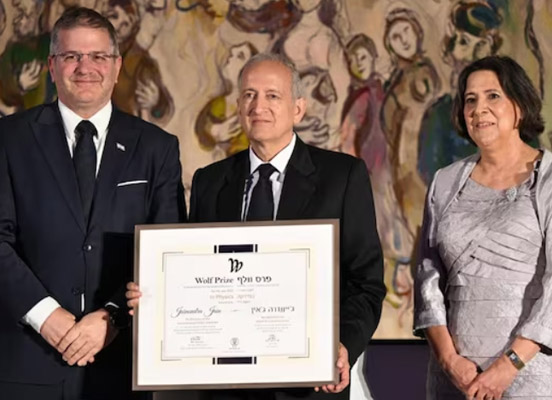
New York: Professor Jainendra K Jain, one of the world's leading theoretical physicists, has been awarded the prestigious Wolf Prize in Physics for his groundbreaking discovery of composite fermions, a breakthrough that revolutionised the understanding of the quantum world.
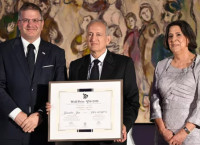
The award was presented by Israeli President Isaac Herzog at a state ceremony in Jerusalem on June 18, making Jain the first person of Indian origin to receive the Wolf Prize in Physics since the award was established in 1978.
Often regarded as one of the highest honors in science after the Nobel Prize, the Wolf Prize has an impressive record of recognizing future Nobel laureates. Twenty-seven previous recipients of the physics prize have later gone on to win the Nobel.
Jain's award recognizes a discovery he made in 1989 while working as a postdoctoral researcher at Yale University. At the time, physicists were struggling to explain the mysterious fractional quantum Hall effect, a quantum phenomenon observed when electrons behave in unexpected ways under extremely strong magnetic fields.
During what Jain has described as a moment of sudden insight while doodling during a television commercial break, he realized that electrons could bind with tiny quantum vortices to form entirely new particles. He named these particles "composite fermions."
The idea provided an elegant explanation for the puzzling experimental observations and quickly became one of the most influential concepts in modern condensed matter physics. The theory predicted specific patterns now known as the "Jain sequences," which have since been repeatedly confirmed through experiments.
Today, composite fermions remain central to research into exotic quantum states and next-generation quantum computing technologies.
Prof Jain's journey to scientific prominence began far from the world's elite laboratories.
Raised in Sambhar, a small town on the edge of Rajasthan's Thar Desert, he developed an early fascination with physics after reading about Indian physicist Satyendra Nath Bose and his collaboration with Albert Einstein.
His path was marked by tragedy when, at age 12, a tram accident in Kolkata claimed his mother's life and left him with severe injuries that resulted in a lifelong disability. The low-cost Jaipur Foot prosthetic enabled him to walk again and continue his education.
He went on to earn degrees from Maharaja College Jaipur, IIT Kanpur and Stony Brook University in New York before building a distinguished scientific career in the United States.
Currently, the Evan Pugh University Professor at Pennsylvania State University and Founding Director of the Lodha Theoretical Physics Institute in Mumbai, Jain has authored more than 250 scientific papers and remains a leading figure in theoretical physics.
"Physics has given me far more than I could ever have imagined," Jain said after receiving the honor. "The opportunity to spend a lifetime trying to understand nature is a privilege beyond measure."