By Bishal Kalita & Khushbu Bura Gohain
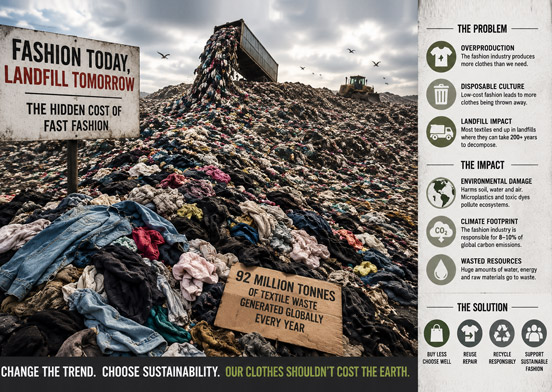
Every day, somewhere in India, a garment is discarded. It might be a polyester kurta bought on a flash sale, a fast-fashion T-shirt that survived three washes, or a blended synthetic that was never designed to last. It enters India’s waste stream and, with overwhelming probability, disappears into a landfill or goes up in smoke in an incinerator, releasing PM2.5, dioxins, and volatile organic compounds that impose a real health cost on surrounding populations.
And it does this, at an industrial scale, while the country simultaneously imports virgin petrochemical fibres to make the next round of cheap garments. This is a structural gap within India’s fast fashion segment, and the cost of having it unaddressed grows every year.
India’s textile and apparel sector is currently in the middle of a compounding growth story. It has expanded to nearly $190 billion in 2025-26, and is projected to reach an ambitious $350 billion by 2030.
It employs over 45 million people, exports to more than 100 countries, and sits at the centre of the government’s growing manufacturing ambitions. Yet, beneath this boom lies a structural inefficiency: as domestic consumption increasingly mirrors the Western “take-make-dispose” model of fast fashion, India is quietly burying immense recoverable value along with its waste.
India currently generates approximately 7.25 million tonnes of textile waste annually. Of the post-consumer textile waste out of this, nearly 45 per cent never enter any recovery pathway, losing not just embedded value but also shedding microplastics into water and soil that enter the food chain at scale.
The manufacturing segment, to its credit, maintains near-exemplary efficiency: pre-consumer waste, comprising factory offcuts and production scrap, shows recovery rates of 95 per cent, underpinned by established commercial networks that keep manufacturing waste in circulation.
The systematic gap exists entirely downstream, in post-consumer waste, where fast fashion now dominates. India currently realizes ₹22,196 crore in value from its entire textile waste stream. Under an optimised circular system, the figure could rise to ₹99,801 crore, leaving a gap of approximately $9.4 billion.
The primary reason this gap exists is fast fashion: its unlabeled synthetic blends have overwhelmed a recovery infrastructure built for cotton-heavy bases. The mechanics of this gap are specific: over 95 per cent of sorting in India is still done manually, largely by women in India's informal economy, from neighborhood ragpickers to the vast shoddy-yarn clusters of Panipat.
This means without standardized grading frameworks, sorters cannot identify synthetic ratios in unlabelled blended garments by touch alone, and recyclable materials default to disposal. Sitting behind this is an even deeper gap: India’s existing recycling clusters are dominated by mechanical processes that are well-suited to cotton-heavy bases that rapidly degrade the structural integrity of synthetic blends.
These are not merely technical shortcomings. Chemical recycling, which breaks fibres down to the molecular level to enable true textile-to-textile loops, is emerging as an alternative but remains far from commercial scale. These are not merely technical shortcomings; they highlight a significant gap in recovering what India discards.
And yet recycling, for all its challenges, is only the smaller half of the opportunity. The FICCI-RECEIC report finds that nearly 85 per cent of the unrealized value lies in reuse; resale, refurbishment, and second-hand markets that keep garments in circulation before they ever reach the waste stream.
India’s recovery ecosystem, such as it exists, is built almost entirely around the smaller opportunities, while the larger ones go unaddressed. The result is that India imports petroleum-derived synthetic fibres, manufactures disposable garments, exports them through supply chains it does not control, and then landfills the post-consumer waste domestically, rather than treating discarded textiles as localized secondary raw materials that could reduce dependence on the very imports creating the vulnerability.
Breaking out of this requires a policy that targets mass-market fast fashion, where the growth is most aggressive, but the collection pathways are non-existent. While organized resale platforms exist, they cater almost entirely to premium brands, leaving cheap, high-volume garments to default straight to the landfill.
The missing link to it is the restructuring of the forthcoming EPR framework. Firstly, it must mandate a brand-funded take-back obligation, compelling fast fashion producers to finance collection infrastructure required to route wearable garments to resale and non-wearables to recycling.
Second, it must be deeply eco-modulated: brands profiting off complex synthetic blends, short-lifespan garments, or high-volume disposable collections must pay materially higher end-of-life levies than those producing durable, recyclable goods.
By using EPR to force brands to both finance collection and pay for their material complexity, India can bridge the structural gap and connect the waste stream directly to the value chain.
To further anchor both tracks, India must urgently move the draft notification on mandatory fibre content labelling into law, forcing manufacturers to disclose exact composition percentages on every product sold domestically. It is a single regulatory stroke that solves two massive crises.
For recycling, it instantly eliminates the manual guesswork that makes automated sorting of blended fabrics impossible. For reuse, it hands graders and resale platforms the data they need to accurately assess longevity and care requirements, separating what can be resold from what is destined for rags.
Finally, policy must meet private capital to scale the heavy-duty processing infrastructure that both tracks desperately need. For the reuse track, the government must extend infrastructure subsidies to establish formal, technology-backed sorting and refurbishment hubs to process mass-market garments at scale.
Simultaneously, for the recycling track, the state must extend Production Linked Incentive (PLI) benefits to advanced textile-to-textile chemical recycling and formally reclassify post-consumer synthetic waste as industrial feedstock rather than municipal refuse. By financially backing the infrastructure for both refurbishment hubs and chemical recycling plants, we can finally close the loop for both segments.
India has the workforce, the waste volumes, the private capital, and the policy architecture beginning to evolve. What is currently lacking is the urgency to treat fast fashion not as a consumer trend to celebrate, but as an industrial liability to regulate. The clock is not waiting, and neither are our landfills.
(Bishal Kalita is a Research Associate and Khushbu Bura Gohain is a Research Assistant at Pahlé India Foundation)
REFERENCES:
https://www.pib.gov.in/PressReleasePage.aspx?PRID=2224408®=48⟪=2®=48⟪=2
https://receic.com/wp-content/uploads/2026/05/textile-report-1.pdf