The success of India’s digital health mission will depend not only on technological innovation but on whether the platform is reshaped towards inclusion, accessibility, and sustainability.
By Deepabali Bhattacharjee
Digital Health is our future when it comes to the healthcare system. Post the Covid-19 pandemic, many countries accelerated the use of digital health tools, including telemedicine platforms and health apps, where technology promises to bridge long-standing gaps in access.
However, it is difficult in a country like India, where the majority of the population resides in rural areas (almost 68 per cent), and most of the advanced health care infrastructure is confined to cities only. Data suggests that expansion of digital health, while significant, remains uneven and exclusionary. Rather than democratizing healthcare, it is important to address existing inequalities in a digital form.
According to the Telecom Regulatory Authority of India report (March, 2026), Rural Internet Subscribers per 100 population is 47.63 per cent. Therefore, the first constraint is infrastructural. Digital health assumes reliable internet access, but this is far from reality.
From an economic perspective, this is an example of a binding supply-side constraint, where, without connectivity, the marginal benefits of digital health innovations cannot be realized, regardless of demand.
Surprisingly, even if access to the internet exists, usage remains limited. Some evidence points to a striking gap between digital access and digital health adoption. Therefore, this emphasizes a thorough and deeper understanding that infrastructure is undoubtedly important, but literacy, familiarity, and trust require sufficient attention.
The promise of digital health lies in reducing transaction costs—travel time, waiting periods, and information asymmetry. However, when access to digital tools is uneven, these efficiency gains accrue disproportionately to already advantaged groups. The result is not a reduction in inequality, but a redistribution of benefits in favour of the digitally connected.
The role of trust and regulation highlights additional challenges. Digital health platforms operate in a relatively under-regulated space, usually raising major concerns about privacy of data, quality of care, and accountability. For rural populations who are already sceptical about formal healthcare systems and trust local (informal) doctors, these uncertainties can further demoralize digital healthcare.
Therefore, the absence of robust institutional frameworks thus compounds the problem of access. Thus, we can categorize this issue into three parts. First, an Access divide, where a large portion of the population lacks the internet connectivity required for digital health.
Secondly, the usage divide where a significant proportion of the population with internet access do not engage with digital health platforms because of capability constraints. And third, Outcome divide, where the benefit of digital health is largely concentrated in urban and economically better-off sections of the population.
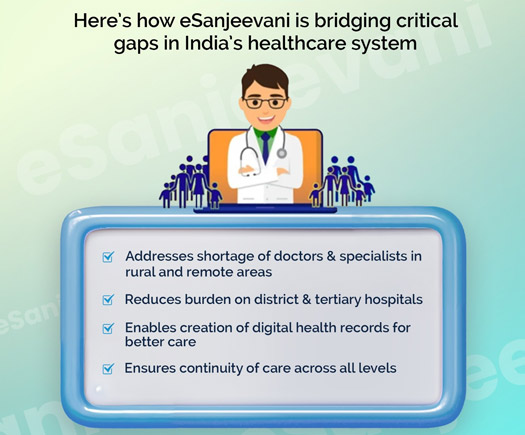
Thus, addressing this ‘Digital Divide’ deserves attention towards a shift in policy perspective. This cannot be dealt with only as a technological innovation but as a public good that requires inclusive design and equitable distribution. The National Telemedicine Service (eSanjeevani) is committed to overcoming challenges such as a shortage of doctors and specialists, overburdened district and tertiary hospitals, the absence of health records, and improving the healthcare journey across different care levels. It ensures quality healthcare at the doorstep of every Indian, ensuring easy, equitable, and timely access to medical facilities.
However, it is important to consider the digital divide in a three-fold segment. The trajectory of India’s digital health is no longer a question of expansion, but rather equitable design. Persistence of low rural connectivity and limited digital literacy suggests that access alone does not translate into utilization. It is a need of the hour to move beyond scale and think about effectiveness.
Our National Telemedicine Service (eSanjeevani) needs deeper integration with community health workers in order to act as intermediaries for digitally excluded populations. Secondly, investments in digital infrastructure that reach the marginalized section of society should be prioritized so that Digital healthcare is not restricted by connectivity gaps.
Third, and most importantly, our focus should be on more user-centric apps, which is possible by incorporating regional languages, voice-based interfaces, and simplified navigation to address capability barriers. Also, there should be sufficient monitoring and accountability.
Data on usage patterns and regional disparities will help interventions be more efficient. This indicates a very important issue that ‘Digital Health’ cannot operate alone; it must be integrated with a broader framework of public health investment.
Therefore, the success of India’s digital health mission will depend not only on technological innovation but on whether the platform is reshaped towards inclusion, accessibility, and sustainability. On this World Health Day, the challenge is to ensure that its benefits are equitably distributed.
The goal should not be only connectivity, but meaningful access that also recognizes the fact that healthcare equity cannot be downloaded, but must be built into the system itself.
----------------------------------
(Dr Deepabali Bhattacharjee is a faculty member of the Economics and Public Policy at the Indian Institute of Management in Haryana, India.)
The views expressed are personal and not necessarily those of The South Asian Times.