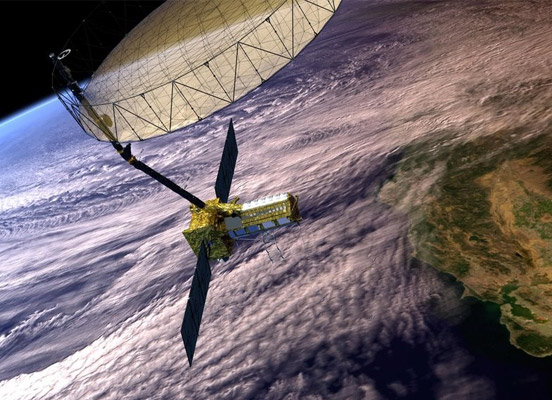
The NISAR satellite, a collaboration between NASA and ISRO will provide a three-dimensional view of Earth in unprecedented detail
New York: The Earth-observing satellite, a first-of-its-kind collaboration between NASA and ISRO (Indian Space Research Organisation), carries an advanced radar system that will help protect communities by providing a dynamic, three-dimensional view of Earth in unprecedented detail and detecting the movement of land and ice surfaces down to the centimeter.
The NISAR mission will lift off from ISRO’s Satish Dhawan Space Centre in Sriharikota, on India’s southeastern coast. Launch is targeted for no earlier than late July.
NASA’s Jet Propulsion Laboratory in Southern California will stream the briefing live on its X, Facebook, and YouTube channels.
With its two radar instruments — an S-band system provided by ISRO and an L-band system provided by NASA — NISAR will use a technique known as synthetic aperture radar (SAR) to scan nearly all the planet’s land and ice surfaces twice every 12 days. Each system’s signal is sensitive to different sizes of features on Earth’s surface, and each specializes in measuring different attributes, such as moisture content, surface roughness, and motion.
These capabilities will help scientists better understand processes involved in natural hazards and catastrophic events, such as earthquakes, volcanic eruptions, land subsidence, and landslides.
Additionally, NISAR’s cloud penetrating ability will aid urgent responses to communities during weather disasters such as hurricanes, storm surge, and flooding. The detailed maps the mission creates also will provide information on both gradual and sudden changes occurring on Earth’s land and ice surfaces. To learn more about NISAR, visit:https://nisar.jpl.nasa.gov/